Tuesday, March 03, 2015

Tony Abbott, please keep your promise and retain the RET

Open letter to Josh Frydenburg, Kooyong.

Josh, 

Late last year Prime Minister Abbott broke an election promise when he called for devastating cuts to the Renewable Energy Target. 

This week the Abbott government has used national media channels to deliver veiled threats: take our offer to slash the Target to around 31,000 GWh, or we'll walk. 

I ask that you represent my views in the Australian parliament and your Party Room on retaining the RET in its current form. 

Solar energy is a clean renewable solution for the future. You are attacking on solar energy if you reduce the RET, and breaking a clear election promise. 

Please keep the Renewable Energy Target strong. The Renewable Energy Target is one of the most successful pieces of nation building legislation in past years. 

Not only has the Target helped more than 5 million Australians go solar, it also benefits the entire country - increasing investment, growth, jobs and regional development. 

Yours sincerely, 
Peter Campbell
[home address supplied]

====================

You can send an email like this to your local MP, asking them to retain the RET and stop attacking renewable energy, from [here] 

Thursday, February 26, 2015

Tony Abbott, the Game of Thrones and why party politics is failing

Its interesting to watch the decline of Tony Abbott as Prime Minister.  I was concerned when he became Prime Minister that he would not be a good leader.  My worst fears have since been realised.

Tony Abbott: Source

The list of broken promises and bad policies gets longer almost every day, here are just a few:
  • Funding cuts to ABC and SBS (a broken promise and appalling "efficiency levy lie)
  • "Loggers are the ultimate conservationists" and "no more national parks" (appalling lie)
  • "Coal is good for humanity" (appalling lie)
  • Deregulation of university fees - that could result in $100,000 degrees (no policy for this during the 2013 election campaign)
  • Continued incarceration of asylum seekers (including children) in concentration camps and offshore processing centres - a clears breach of human rights and the UN Convention for Refugees. (Note this is also supported by the Labor opposition)
  • Encouraging Islamaphobia is making Australia less safe, rather than considering the causes of radicalisation of the minority who join the likes of ISIS, and how we can prevent this happening.
  • Lifters and Leaners: vilification of low income earners and protection of corporate tax evaders
  • A budget emergency that actually did not exist, but is now being created by the failed LNP budget and policies.
  • Ongoing denial of climate change accompanied by policies that are crippling our transition to renewable energy and a zero carbon future.
  • The proposed GP Copayment - research indicated that this will have a negative effect on health care outcomes and greatly disadvantage low income earners.
All these policies have a common thread - they are based on ideology rather than evidence.

However, for all this I don't just blame Tony Abbott.  

We have serious systemic problems with political parties, where their policies come from, how their leaders are elected, and the basic failure of representational democracy.

Political parties actually only represent their own traditional support bases:
  • Liberal - medium to high income earners, "the big end of town" corporates, media barons etc. Notional "conservatives".
  • Labor - "working families", unions (some but not all), Notional "progressives" etc
  • Greens - conservationists, some unions, progressives disillusioned with Labor and the Coalition
  • Nationals - the notional "rural vote"
The average citizen has next to zero input into party policies.  Many actual party members (a small fraction of voters) also have little or no input to party policies.

Party policies come from secretive processes that are largely controlled by internal and vested interests.

The basic failure of representational democracy is twofold:
  1. Yet we vote for our local Members of Parliament, who are supposed to represent us. In reality, they vote the way their party instructs them most of the time.
  2. Parties have policy platforms during an election that are not binding - promises are routinely broken once government and policies that were not part of their election platform are forced onto society.
Our Prime Ministers are selected by internal party processes such as Party Room votes.  There is never any public participation with this - MPs decided when to sack a sitting Prime Minister and appoint a new one.

Recently, this has been chaotic.

The Labor Party sacked Kevin Rudd due to internal problems they had with his autocratic leadership style.

The Labor Party then sacked Julia Gillard and reappointed Kevin Rudd because nervous Labor MPs thought she couldn't win the 2013 election - which Rudd went on to lose.

Malcolm Turnbull was deposed as Coalition Opposition Leader in 2009 by the Liberal Party room, many of whom were concerned by his bipartisan support for an emissions trading scheme.  Tony Abbott won by one vote and went to become Prime Minister.

Now in 2015, it is evident to the wider electorate that Tony Abbott is manifestly unsuitable for the role of Prime Minister, so nervous back benchers (scared of losing their seats) bring on a "vote of no confidence" in him, which is defeated (61 votes for him, 39 against) with no alternative candidate. 

Since then, Abbott has continued to prove himself incapable of governing the country, he is locked into "attack mode" where he insists he well "beat Bill Shorten" and he continues to bully and threaten anyone who doesn't agree with him such as Human Rights Commissioner Gillian Triggs.

It now seems likely that the Coalition Party Room will vote again on who will be Prime Minister (if someone challenges) and that Tony Abbott is considered likely to now lose.

So these are some big problems.  

Here are some possible structural solutions:

Constitutional change: Form governments based on the skills of elected MPs rather than party allegiances and membership

Constitutional change: Ban binding party votes - make every vote a conscience vote

Constitutional change: Provide voters with the opportunity to directly elect political leaders (e.g Prime Minister, Head of State) and move to some form of Republic

Legislative change: Ban large political donations - these fundamentally corrupt politics as they buy influence and large media driven election campaigns.

Constitutional change: Citizen initiated referendums and issue/policy referendums - give voters the opportunity to vote on binding policy matters that governments must then implement.

If we don't reinvigorate our democracy will continue to be subjected to the whims and vagaries of a largely autocratic political elite that don't act in the best interests of the nation and all citizens.


Tuesday, December 02, 2014

Why roads are not suitable for mass transportation

The now departed Napthine government was hell-bent on spending up to $16b on the "East West link" tollway tunnel project, claiming that it would "be the transport infrastructure that Melbourne needs".  They included fanciful claims including that the new tunnel would:
  • Reduce commute times by 20 minutes
  • Reduce congestion on Hoddle Street
Both claims are patently false.  The Napthine government lost he election held on 29 November and the incoming Premier, Daniel Andrews, has pledged to stop the East West Link road project  proceeding.

Similar claims were made by Jeff Kennet back in the 90s when he claimed the City Link road project, constructed between 1996 and 2000 would "will solve Melbourne's traffic problems". Clearly, it has not.

However, there is another good reason why roads cannot provide a suitable mass transport system for a city such as Melbourne - every driver is a single point of failure.

Nearly every day there is a crash which can close or seriously disrupt traffic on a route.

Six cars and a truck were involved in two crashes on the West Gate Bridge. Photo: Seven News

For example,a crash closed the West Gate Bridge on Tuesday 2 December. Such crashes and closures are now a daily occurrence.

By comparison, trains carry up to 800 passengers with a single driver - and don't have to contend with road intersections and "lane changes".

We need some real political leadership to build more train lines and revise the train network for Melbourne - given that no new suburban rail lines have been built since the Glen Waverley line in 1932.

A dedicated safe bicycle path network should be included too.

Links

Thursday, September 11, 2014

Labor finally opposes disastrous East West Tollway Tunnel

Finally, after months of obfuscation and weasel words, the Labor party has stated that they won't honour any contracts signed for the ill-considered East West Link (road tollway tunnel) that the Napthine Liberal National Government is hell bent on building.

Up until now, Labor has said "they oppose the tunnel but they will honour contracts signed by the Napthine government" - which means they effectively supported the tunnel as it would proceed if they win the election.

This was always nonsense as the Victorian Government is NOT exposed to any sovereign risk if bidders for the project know that the next government might not proceed with the project.

Now, at last, Daniel Andrews has made this statement - that if elected, a Labor government will not proceed with the project.

There are very good reasons they should do this, as I presented to the Assessment Panel, including:
  • The project cost/benefit has not been fully disclosed, and what is known has been proven to be false.  The project will not generate a net return to the community, it will be a net cost.
  • The tunnel will not reduce congestion as it will encourage more traffic and the destination of only 95% of people travelling on the Eastern Freeway system is the CBD, north or south, not across to the Tullamarine.
The $8b would be much better invested in upgrading Melbourne's train network, including building new train lines and bike paths such as the North East Bicycle Corridor.  You can also sign this petition to build the NEBC.

Links

Monday, August 11, 2014

Letter to Josh Frydenberg: Please drop your proposed mandatory data retention regime

Josh,

I ask you to drop your proposed mandatory data retention regime.

Police and intelligence agencies already have broad powers to request information about the communications of specified individuals be retained to support their investigations.

What you are seeking now is for that information to be retained for two years for ALL Australians, even if you're not being investigated.

You  want the following information retained:

Phone calls: detailed records of phone calls you make and receive, including the two numbers. If a mobile phone is involved, that will include the location of that phone, resulting in a detailed record of your location and movements being collected. See this example to understand just how revealing this information can be.
Email: detailed records of who you're sending emails to and receiving them from.

George Brandis provided confusing and conflicting information about whether details of web browsing are to be included.

You do want to retain a record of the address assigned to connections  when you access the Internet (originating IP address). This information will allow the police and ASIO to identify who has visited specific websites that are of interest to them. It will also allow copyright owners (via subpoena) to identify people they believe are infringing their copyright, by downloading or file-sharing.

Even without web browsing information included, a mandatory, society-wide data retention regime represents a massive invasion of the privacy of all Australians. It also subverts the principle of presumption of innocence by treating us all as potential suspects.

There will be substantial costs associated with implementing such a regime. One estimate is that it will add $100 per year to each internet bill.

The massive databases of highly sensitive (and valuable to organised criminals) information will also be highly prone to hacking and misuse, posing genuine threats to the safety of many Australians.

There are already more than sufficient powers available to Australia's intelligence and law enforcement agencies to have information retained about communications involving 'persons of interest'. There is no justification for this information to be retained on the rest of society.

I call on the Federal Government to drop its proposed mandatory, indiscriminate data retention regime, and to treat ordinary, law-abiding Australians as Citizens, Not Suspects.

Regards, Peter Campbell


Sign the Citizens Not Suspects petition, GetUp!


Sunday, August 03, 2014

Open letter to Josh Frydenberg: Please retain or increase the RET

Josh,

You recently voted against Australia's carbon tax.

Please do not compromise Australia's Renewable Energy Target.

The RET is a very important and effective mechanism for transitioning Australia towards zero emissions clean energy.

The RET has only contributed 8% to electricity price increases from 2007/08 to the present.

The Carbon Tax only contributed 16%.

Over this same period distributor costs and charges have contributed 70% to electricity price increases

Investment in renewable energy has risen $5 billion per year.
Renewable energy capacity has almost doubled from 2001 to 2012.
86% of Australians think that Australia needs more renewable energy.
71% of Australians support the RET
90% of Australians want more electricity from solar
80% of Australians want more electricity from wind.

Overall the RET comprises only 3% of the total price of electricity bills.

Please support meaningful action on climate change and transitioning Australia to a new economy with clean energy and associated local industries and jobs.

For example, there are very significant opportunities for local manufacturing and services industry jobs around the Geelong region if more wind farms are built.

Regards, Peter Campbell
[address supplied]

=====================
Response from Josh Frydenburg 27/8/14

Dear Mr Campbell

Thank you for writing to me concerning the review into the Renewable Energy Target (RET).  I have noted your views. For your information the review has been established to allow the general public to make submissions to the Government.

As you are aware, the Government has released the Terms of Reference for a review into the RET, upholding a clear commitment to ensure the RET is working efficiently and effectively and to meet a legislative requirement for a review to be conducted in 2014.

An independent expert panel which brings together extensive policy, business and energy sector expertise will lead the review. The chair of the review, Mr Dick Warburton, has had an extensive career in business and industry, including time as a board member of the Reserve Bank of Australia.  Mr Warburton was appointed by the former Climate Change Minister in the Labor Government, Senator Wong, to head its Emissions Intensive Trade Exposed review under the CPRS process.

The Terms of Reference include examining the economic, environmental and social impacts of the RET, in particular the impacts on electricity prices, energy markets, the renewable energy sector, the manufacturing sector and Australian households. The review will be mindful of sovereign risk issues in any proposals it may present to the Government. Unlike the pattern from the previous Government, the review will be open and transparent and engage in consultation with a broad range of stakeholders, seeking submissions from the public and industry.  The review will be supported by a Secretariat based in the Department of Prime Minister and Cabinet involving specialists from the Departments of Environment, Industry, Treasury and the Clean Energy Regulator.

The Government will receive the report by the middle of the year and it will provide important input into the Government’s Energy White Paper.

Thank you once again for writing to me about this matter.

Yours sincerely

Josh Frydenberg
Federal Member for Kooyong | Parliamentary Secretary to the Prime Minister
Parliament House Office | a: R1:44 Parliament House, Canberra ACT 2600 | p: 02 6277 4606 | f: 02 6277 8546
Electorate Office | a: 695 Burke Road, Camberwell VIC 3124 | p: 03 9882 3677  |  f: 03 9882 3773
Email: josh.frydenberg.mp@aph.gov.au  |  Website: www.joshfrydenberg.com.au

Thursday, July 31, 2014

Get your skin checked regularly for melonomas

I visited my local GP recently when I was recuperating from my broken shoulder.  He also examined my back and said I should get a dark patch of skin checked as it had a darker spot in the centre.

I visited Dr Segal, a dermatologist in Camberwell, who agree it should be removed.  He excised it a week later after I returned from a short holiday in Queensland.  I look at the piece of skin - it was slightly smaller than a 20c piece and had a circle of darker pigmentation about 10mm round with darker spot in the middle.

Four days later I returned to have the dressing changed. Dr Segal informed me that it was a melanoma (skin cancer) about 0.4mm deep, which meant that it was detected early.

Four days later I got the dressing changed again and Dr Segal said that the melonoma showed signs of regression - my body's immune system had been fighting the tumour and it may have been bigger.  He recommended that more surrounding skin and tissue be removed as a precaution -a "wide clearance".

He took more out at about 7 days after the first excision.  The local anaesthetic blocks the pain but once in wore off I certainly felt sore for a couple of days.

The second excision was also sent to pathology and came back clear, so it would seem there will be no further action required.

Skin cancer (Melanoma) is scary - there is no blood test for it, and if they go undetected and spread throughout the body then its virtually a death sentence.

Here's a photo of the second scar.


My back has not been exposed to sun much for the last couple of decades, but I did get sunburnt occasionally during my childhood.

If you don't get your skin checked by your GP or a dermatologist, consider doing so.

I am also now taking Vitamin B3 (Nicotanimide) tablets as they can act to block the immuno-suppression effect that UVA and UVB has on the skin, thereby possibly preventing melanomas forming.

Sunday, July 27, 2014

2014 Victorian state election priority issues

Here is my list of priority issues for the 2014 Victorian state election

Transport
  • The East West Link tunnel road project should not proceed.
  • Public transport network plans for 2014-2020
  • Funds allocated to building a safe and comprehensive cycling network segregated from cars - 
  • Cycling network plans for 2014-2020 - aiming to provide a connected safe bike route to within 5km of every Melbourne resident.

Environment
  • Logging in Victoria's native forests should cease.
  • The Great Forest National Park to be proclaimed.
  • A complete overhaul of our train network - and new lines built to the airport, Rowville and Doncaster
Education
  • State secondary school system needs more resources and funds.
Housing
  • 7 star efficiency rating for buildings - commercial and residences
Energy
  • Energy plan to increase renewable energy production to 80% of total demand by 2020, including investment is solar and wind power and local energy storage capacity

Wednesday, July 23, 2014

My email to the 39 Senators who voted for the Carbon Tax Repeal

You recently voted against Australia's carbon tax.

Please do not compromise Australia's RET.

The RET is a very important and effective mechanism for transitioning Australia towards zero emissions clean energy.

The RET has only contributed 8% to electricity price increases from 2007/08 to the present.

The Carbon Tax only contributed 16%.

Over this same period distributor costs and charges have contributed 70% to electricity price increases

Investment in renewable energy has risen $5 billion per year.
Renewable energy capacity has almost doubled from 2001 to 2012.
86% of Australians think that Australia needs more renewable energy.
71% of Australians support the RET
90% of Australians want more electricity from solar
80% of Australians want more electricity from wind.

Overall the RET comprises only 3% of the total price of electricity bills.

Please support meaningful action on climate change and transitioning Australia to a new economy with clean energy and associated local industries and jobs.

Total Electricty cost increase 2007/08 to present
Wholesale costs 55 5%
Distributor costs & charges 746 70.4%
Carbon Price 172 16.2%
RET 87 8.2%
$1060


You can send your own email to the 39 Senators here: http://www.savetheret.com/

Links

Thursday, July 03, 2014

Is Tony Abbott assembling the apparatus of a fascist state?

Is Tony Abbott assembling the apparatus of a fascist state?

I see some worrying trends, such as:

  • Tell very big lies, such as "I am a conservationist" and "Loggers are conservationists"
  • Backflip on several critical election commitments.
  • Tell further lies such as "I have not told lies, I have not broken election commitments"
  • Pretend there is a "budget emergency" when there isn't - and use this to justify bad policies such as GP CoPayments and dramatically increasing the cost of tertiary education and student HECs debts

  • Criticise the ABC for having a "left-wing bias"
  • Insert Janet Albrechtson  - a trenchant critic of the ABC - onto the ABC and SBS Boards
  • Demonise asylum seekers who attempt to enter Australia by boat, equate them with terrorists, deny them their human rights under the UN Convention for Refugees and incarcerate them in "offshore processing centres" for indefinite periods.  Keep saying that all this is a "border protection issue"
  • Support corporate fossil fuel interests and encourage ongoing carbon pollution despite clear scientific evidence and consensus that carbon emissions are causing global warming
  • Attack and undermine renewable energy projects - with more lies such as "the RET is responsible for electricity prices rises"
While these developments are still a long way from a fascist state, there does seems to be a direction towards this.

Against this trend is the curious Federal push by Abbott to "eliminate red and green tape" and "hand back powers to the (Australian) States"

According to Wikipedia, the characteristics of a fascist state are:
  • Radical authoritarian nationalism
  • Combining more typically right-wing positions with elements of left-wing politics
  • Opposition to liberalism, Marxism, and traditional conservatism. 
  • Unify the nation through an authoritarian state that promoted the mass mobilization of the national community
  • Leadership that initiates a revolutionary political movement aiming to reorganize the nation along principles according to fascist ideology.
  • The veneration of the state
  • Devotion to a strong leader
  • An emphasis on ultra-nationalism and militarism. 
  • Fascism views political violence, war, and imperialism as a means to achieve national rejuvenation,and it asserts that stronger nations have the right to expand their territory by displacing weaker nations.
  • Replaced socialism's focus on class conflict with a focus on conflict between nations and races.
  • A mixed economy, with the principal goal of achieving autarky to secure national self-sufficiency and independence through protectionist and interventionist economic policies.
  • Ideological dishonesty
  • Emphasizes direct action, including supporting the legitimacy of political violence, as a core part of its politics
Fascism maybe an old term, usually used pejoratively by political opponents, that maybe no longer relevant in today's world.  Hopefully this is the case.

More on this to follow.

Links

Monday, June 23, 2014

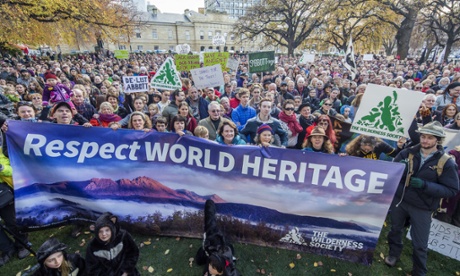
Open letter to Josh Frydenberg: Your attempt to delist Tasmanian forest is very wrong

Open letter

TO: Josh Frydenberg, MP for Kooyong.

I wish to draw to your attention that the Abbott government's attempt to withdraw the World Heritage nomination of Tasmanian forests is very wrong.

Tasmania world heritage area rally: the committee will hand down its decision late on Monday night. Photograph: Rob Blakers/AAP Image
The IUCN has found that, contrary to your government’s claim that the area was heavily degraded, that:
  • 85% of the 74,000 hectares was natural forest 
  • 45% is old-growth forest. 
  • Just 4% could be described as heavily disturbed by logging, roads and other infrastructure. 
Eric Abetz and Tony Abbott have grossly misrepresented this situation and told outright lies about this forest nominated for protection.

I wish you to represent my views on this in the Australian Parliament. Could you please confirm to me when you do this and provide me the the Hansard reference?

Regards, Peter Campbell
Home address supplied

Monday, June 16, 2014

Another war in Iraq?

I protested outside Peter Costello's residence with about 30 other people when John Howard committed Australia to the war in Iraq "against Saddam Hussein's weapons of mass destruction".  At the time, I was concerned that military intervention in Iraq would create ongoing instability in the Middle East and exacerbate terrorism.

Imagine if another nation came to Australia and waged war against us because they thought we were up to no good!

So George Bush, Tony Blair and John Howard had their war, without approval from the United Nations, and with no compelling evidence that WMDs were still there.

They may have won some battles, but they were never going to "win the war".

Tens of thousands of Iraquis died.

Sectarian communities such as the Shiites, the Sunnis and the Kurds have become even more polarised

The attempt to force western-style democracy on Iraq has failed.  The dominant Shiite majority has not formed consensus among minorities and corruption is an ongoing problem.

There has been regular suicide bombings and improvised roadside bombs - these have been conducted by "insurgents" - including locals who hate being occupied.

Now ISIS has displaced the shaky Iraqui government forces from the North and are moving towards Baghdad.  A civil war has now started.

Tony Abbott stated to Obama during his visit to the United States that he "wouldn't rule out Australia participating (again) in another military intervention" and that "Australia would support the United States".  So it appears he thinks the decision to commit Australia to another foreign war is his alone, rather than the Australian Parliament.

I don't think any political party (or its Party Room) should have the right to make this decision. I believe that a 75% vote of all Australian parliamentarians should be required for this.

If Australia, the United States and Great Britain go back to Iraq for another war this will solve nothing and create more problems like those we have already seen.

It would be an unwinnable war with catastrophic consequences. 

Saturday, June 07, 2014

Napthine Govt spends more on Frankston line upgrade than all other lines combined

Melbourne's metropolitan rail network is in a chronic state of disrepair. The entire system needs a complete overhaul after decades of neglect.  Signals regularly fail,  tracks buckle in the heat, and most stations lack adequate shelter.

No new suburban train lines have been built in Melbourne since the Glen Waverley line in 1932. Critical rail projects that should now be servicing growing communities where over a million people don't have close access to trains include the Rowville line (including Monash Uni and Chadstone), the Doncaster Line (if the East West tollway tunnel proceeds it may never be built).

It is galling to see the Napthine government, driven by politics and its desire to be re-elected, has allocated more funding ($100m) on one line than all other lines combined.

The Bayside Rail Project, that services the marginal seat of Frankson, includes upgrading tracks, repairing overhead wires, painting stations, works on signalling and level crossings and installation of new SPOT monitoring systems which replace mirrors with cameras to provide train drivers with a better view of passengers getting on and off trains at platforms.


The harsh reality is that these type of works are urgently required on all sixteen existing lines. At a rough estimate this could require 1 to 2 $billion.

The overall scope for all Metropolitan rail network projects is:
  • $177 million for eight X’Trapolis trains and associated stabling and signalling. The trains are due to begin running on the network from 2015.
  • $66 million to upgrade the Ringwood station precinct.
  • $2 million to plan for high capacity trains, which will be able to carry more than 1100 passengers.
  • $4.5 million in 2013-14 to develop the pilot High Capacity Signalling project on the Sandringham line.
  • $100 million to upgrade the Frankston line, with additional track, signalling, power and maintenance facility and station upgrades to improve service reliability and enable X’Trapolis trains to run on the Frankston, Williamstown and Werribee lines. 
  • $78 million to continue the rollout of Protective Services Officers (PSOs) at train stations.
  • $10 million to construct a four-level car park at Syndal Station on the Glen Waverley line.
  • Significant funding for the construction of a new train station at Southland, subject to finalisation of commercial negotiations with the owners of Southland Shopping Centre.
100m is allocated to the Frankston line project while only 80.5m is allocated to projects on other specific lines (specific line projects in bold).

While this expenditure on the Frankston line is worthwhile and well overdue, its a great pity that the rest of Melbourne's rail network gets virtually nothing yet again.

We clearly need to separate politics from transport planning to avoid decisions being driven purely for political gain.

Links

Monday, June 02, 2014

A letter to the World Heritage Committee opposing Abbott's attempt to denominate World Heritage listing of Tasmanian forests

 Your Excellency,

I am writing to you as Chairperson of the World Heritage Committee, to bring to your attention my deep distress and alarm at the attempt by the Australian Government to remove 74,000 hectares from the Tasmanian Wilderness World Heritage site.


The decision by the World Heritage Committee to include an additional 172,050 hectares within the World Heritage Area in June 2013 had resolved many long standing threats to the Tasmanian World Heritage site and helped end a conflict that had been dividing Tasmanians for decades.

The decision by the then Australian Government to nominate these areas was only possible because of the strong role played by the World Heritage Committee and it's advisory bodies over the previous 25 years. The integrity and persistence of the Committee and its advisory bodies throughout this process has been exemplary.

The proposal before you by the current Australian Government is politically motivated and is contrary to Australia’s obligations as a signatory to the World Heritage Convention.

The Australian Federal Government has submitted evidence to the World Heritage Committee that large sections of the area under review are severely degraded. This is false - less than 10% of the area proposed for de-listing has been disturbed and the vast majority of this World Heritage Area remains untouched, pristine and wilderness quality natural landscapes.

I urge the World Heritage Committee and you as Chair, to continue to uphold the values and principles of the World Heritage Convention and continue to protect these forests from destruction.

I would be grateful if you could draw my concerns (and the concerns of many other Australians) to the attention of the World Heritage Committee.

Link to Getup letter

Friday, May 23, 2014

The ideal method for evaluating the benefit of co-payments is a proper trial

John Kaldor, Nicholas Zwar 
The Australian,  23/05/2014 

THE government’s proposal for a $7 co-payment for GP visits and laboratory tests is one of the
most hotly debated items in last week’s budget.

Putting aside the “broken promises” issue, most of the criticism of the co-payment has revolved around its fairness. In a purely mathematical sense, a co-payment is a proportionately bigger hit for those on lower incomes, but there is a more fundamental question. What will a co-payment actually do to people’s health?

Basic economics says that a cost increase will reduce demand, which means fewer doctor visits and tests. On the surface, that sounds like it would be unhealthy, but what if people were having consultations they did not need?

The government has in fact claimed several major health bene fits for the co-payments. It believes people will look after their health more if they have to contribute directly to the cost of medical services, and GPs with fewer patients will provide better care to those who do show up.

On the other hand, critics of the co-payments say that health will suffer because people deterred by the co-payment will miss out on care that they need to maintain health. What does the scientific evidence tell us about who is right?

Medical science has well- established techniques for deciding what works and what doesn’t. The ideal method for evaluating health benefit is the randomised trial, which compares groups of people allocated to receive competing forms of “intervention”.

The only large-scale randomised trial of co-payments ever conducted was the Rand Health Insurance Experiment, which took place in the US in the late 70s and early 80s. It found those assigned to the co-payments group used fewer medical services than those with free care. Those on lower incomes had poorer outcomes in several areas of health and for people on higher incomes there was no difference in health outcome.

There was also no difference between the free and co-payment groups in the extent to which people looked after their own health in areas such as diet and smoking.

The Rand trial found that the co-payments reduced use of both needed medical care and unnecessary care, suggesting that people may not be good at making the distinction for themselves.

The Rand trial provided the most methodologically rigorous evaluation of the health effect of copayments, but  it took place more than 30 years ago, in a health system very different to ours.

Since, there have been nearly 50 studies, mainly from Western Europe and Canada, that looked at the impact of co-payments.

Although they did not use the randomised trial methodology, this body of evidence is highly relevant to our current debate about the impact of co-payments.

The studies are consistent in showing lower levels of service usage when co-payments are introduced, and are also generally consistent in showing that people on lower incomes reduce service uptake to a greater degree.

For various methodological reasons, the studies are much less informative about whether the reduction in service uptake systematically led to worse health in the population.

To draw such conclusions, longer timeframes and more detailed data are required, and few studies have had sufficient scope to do so. What is clear is that there is absolutely no evidence introducing a co-payment has any benefit for people’s health.

If a pharmaceutical company proposed marketing a drug that had no proven health benefit, and there was some evidence that it was actually harmful to certain population groups, it would not get past first base with regulatory authorities or clinicians.

That is more or less the position we are in with regard to the health impact of co-payments.

In these circumstances, the argument about whether they should be introduced can certainly not be based on their potential for dir ectly improving health.

If co-payments are to be introduced, the current state of the evidence suggests the very process of their introduction should be through a form of trial that is properly resourced, carefully monitored and perhaps restricted in some way before full-scale implementation is considered.

We now have the ability to track health and health service usage through electronic data bases that protect confidentiality.

If there is any sign from such a trial that people in need of care are being deterred from necessary medical attendance as a result of co-payments, let alone experiencing worse health outcomes, the government would then be in a position to react quickly and make needed modifications to maintain confidence in our health system.

John Kaldor is professor of epidemiology and Nicholas Zwar professor of general practice at the University of NSW.

Tuesday, May 13, 2014

Submission to RET Review - retain RET and don't burn native forests for fuel

13 May 2014

Via https://retreview.dpmc.gov.au/online-submissions

This is my brief submission to the Renewable Energy Target review that you are conducting.
The whole purpose of the Renewable Energy Target (RET) is to address climate change and reduce carbon pollution by bringing more renewable energy into our electricity supply in a gradual and predictable fashion that encourages investment.

The Coalition has promised at the two most recent Australian elections to retain the target. I expect the Government to honour all its climate promises.

I would like the target of 41,000 gigawatt hours of renewable energy by 2020 retained, or preferably be increased to 60,000 gigawatt hours, so that we can move faster to address climate change.
I understand that the present target is costing the average household about an extra dollar a week for electricity.  I am more than happy to pay this small charge to clean up our power generation and reduce carbon pollution.

Native forest wood products must not be classified as an eligible renewable energy source as there are significant net total carbon emissions resulting from logging native forests.  Forest destroyed by logging is not “waste”.  The natural value of forests, their biodiversity, the water they produce and the carbon they store is far more valuable than woodchips and the small proportion of sawn timber produced by logging them.

Burning logging residues resulting from logging native forests will increase carbon emissions and further encourage ongoing logging, destruction and degradation of Australia’s native forests, some of which have been found to be the most carbon-dense in the world.

Peter Campbell
Surrey Hills, Victoria

Thursday, May 08, 2014

Australian needs a national Integrity Commission now


Add your voice to our call to clean up politics

It’s time to for a national corruption watch dog to clean up politics.

Politicians of all persuasions should recognise that the public interest is best served by a clear separation between politics and business.

Recent revelations by state ICACs make it clear that sadly this is not the case in Australia.

That’s why we urgently needs a national Integrity Commission to oversee anti-corruption measures at a federal level in the same way that state ICAC do.

The Australian Greens have called on both Liberal and Labor to urgently consider legislation for a national Integrity Commissioner in light of recent events in NSW politics.

An Australian Greens bill for a national Integrity Commission is already before federal Parliament. Among other integrity measures, the bill would establish a new Office of the Independent Parliamentary Adviser to advise MPs and Ministers on entitlements claims and the ethical running of their office that the public rightly expects. The adviser will also be tasked with developing a legally binding code of conduct for MPs for the Parliament to adopt.

Add your voice to our call to clean up politics:

To the Honourable President and members of the Senate in Parliament assembled:

The petition of the undersigned shows:

Politicians of all persuasions should recognise that the public interest is best served by a clear separation between business and politics.

The Australian public expects their elected representatives to act ethically and in the public’s best interest.

A National Integrity Commissioner would help ensure that this is the case.

Your petitioners ask that the Senate:

Urgently support legislation for a National Integrity Commissioner to oversee and implement anti-corruption measures at a federal level.

Online petition is here

Wednesday, April 30, 2014

Submission: Amendments to the Racial Discrimination Act 1975

Human Rights Policy Branch
Attorney-General's Department
3–5 National Circuit
BARTON ACT 2600
via email

Dear Sir/Madam,

I strongly opposed the proposed amendments to section 18C the Racial Discrimination Act 1975.

The safeguards provided by the Racial Discrimination Act have been in place for almost 20 years, including during the 11 years of the Howard government, giving targets of hate speech a peaceful and legal avenue of redress.

These laws have helped resolve hundreds of cases that would otherwise have been left to fester and to degrade social cohesion.

These laws protect all Australians against racial vilification, not only minority groups, and are one of the few inhibitors we possess against the racism which underpins many overseas conflicts.

I believe that the proposed changes, if passed, will send a dangerous signal that hate speech is sanctioned as a form of freedom of speech, that bigotry has a place in our society.

I do not believe that it is OK in our society to behave or speak like a bigot.

The proposed amendments will encourage those so inclined to take bigotry into the public domain. Even in situations of unambiguous abuse, the victim will be required to prove that the abuse may incite a third party to racial hatred – an extremely difficult test to satisfy.

Those who bring diversity to our country will be more susceptible to racist taunts aimed at their culture, their tradition, their faith, their skin colour. They will be rendered vulnerable to hate speech.  Their protection against this will be compromised.

Our government has a duty to make racism socially unacceptable and to provide the targets of racism with a legal course of action. The proposed changes will take our society in the opposite direction.

I along with over 200 ethnic communities across Australia, including indigenous Australians, oppose the proposed amendments.

I urge the Federal Government to withdraw its Exposure Draft of the Freedom of Speech (Repeal of Section 18C) Bill 2014.

Peter Campbell


Information on how to make a submission via mail or email is available here

Thursday, April 10, 2014

My presentation to the East West Link LMA Assessment Panel

 I delivered a personal presentation to the East West Link LMA Assessment Panel on Thursday 10 April 2014.  Here it is.  You also download it here [PDF]

Supplementary Submission to Comprehensive Impact Statement – East West Link Assessment Committee
Peter Campbell
10/4/14

I cycled along the Eastern Freeway in 1975 before it was opened to traffic from Thomsons Road Bulleen to Alexandra Parade. I recollect this took about 20 minutes, about half the time compared to busy road routes such as High Street Kew.  This highlights how effective cycling can be as a transport mode if safe and convenient cycling infrastructure is available.

The natural course of Koonung Creek, where I often played as a boy, was lost when the freeway was extended over it from Thompsons Road to Doncaster Road.

At the time the freeway was further extended from Doncaster Road to Springvale Road, VicRoads announced they would downgrade the shared bicycle and pedestrian path they had committed to build.  I wrote to the then Minister for Transport and to Garry Liddle, the Eastern Freeway Project manager (now Chief Executive of VicRoads).

Garry Liddle assured me at the time that the Eastern Freeway would:
·         Reduce the amount of traffic on Doncaster Road and other local roads.
·         Not increase the total number of cars used for transport as they would simply shift to the freeway
·         Result in reduced air pollution as car engines on the freeway would be operating at their most optimum level with all vehicles all travelling at around 80km/h
It was quite obvious to me that most of these claims were patently false both then and now.  Doncaster Road may be less busy, but the total number of cars using the freeway has increased greatly. Cars are now often banked up in stop–start traffic back to Tram Road and beyond.

This highlights the myths that are used to falsely and fraudulently justify freeway projects.

For the East West Link, two major myths among many are that 1) it will reduce traffic congestion on Hoddle St (more cars clearly means more congestion) and 2) that it will reduce commute times for those travelling by car from and to outer eastern and south-eastern suburbs.  Chronic congestion on City Link and the Monash Freeway provide clear evidence to the contrary.

In addition, cities such as Los Angeles that have very extensive multilane freeway networks suffer long periods every day when chronic traffic congestion slows them to a crawl. I have personally experienced this.  When operating “normally” these same freeways are also daunting to use due to very fast traffic and multiple required lane changes and confusing interchanges.   The risk and occurrence of serious collisions is very high.


I note that the current plans for the East West Link are highly likely to stop the possible construction of the Doncaster Rail Line due to use of land for the Hoddle Street Interchange and the addition of two extra freeway lanes from Tram Road into Alexandra Parade.


8:05am: Traffic at a standstill on the Monash Freeway
John Karim @SuperFunFunJon
Over 1 hour from Sth Gippy Hwy to Springvale Rd on Monash! At a stand still COME ON!! @mmmhotbreakfast
7:56 AM - 9 Apr 2014

The Age. 9/4/14 7:22am: There's been a crash now in Hawthorn on Auburn Road near Burwood Road. And a reminder Williams Road is likely to remain closed until 9am

Melbourne's wet-weather traffic chaos
http://www.theage.com.au/victoria/melbournes-wetweather-traffic-chaos-20140409-36byv.html
Melburnians heading to work are facing traffic chaos as wet-weather accidents cause road closures and blockages around the city. An early-morning accident involving a reportedly drunk P-plate driver smashing into a power pole on Williams Road, Toorak, has resulted in the road's closure for most of the day

Embarcadero Freeway, San Francisco http://bit.ly/1lPXSaY
A massive, stacked freeway (Route 480) ran right along what is now one of the most scenic views of the bay. The freeway was considered for removal since the early 1980s. Demolition began in 1991 after earthquake damage. The result was a triumph for downtown San Francisco, providing miles of public space, walking and bike paths, plus new transit routes where the double-decker freeway once was. The city helped prove that freeway removal was not only possible but could be an economic boon.

Embarcadero Freeway before

Embarcadero after

The last significant passenger rail line was the Glen Waverley Line, built in Melbourne in 1932. Since then hundreds of kilometres of freeway and tollway projects have been built, including:
  • South Eastern Freeway (also widened as part of City Link)
  • Monash Freeway (also widened as part of City Link)
  • Tullamarine Freeway (also widened as part of City Link)
  • Geelong Freeway
  • Calder Freeway
  • Eastern Freeway, Pennisula Link, East Link etc.


Summary
  • The LNP Coalition Government has no political mandate for construction of the East West Tunnel Tollway – it was not part of their election policy platform (but Doncaster and Airport rail studies were)
  • I consider that there has been no proper assessment of effective transport options for Melbourne’s entire transport needs over the coming decades.
  • Around the world, major public transport projects are providing excellent transport solutions, such as the Delhi, Rome, Los Angeles, Washington and Los Angeles Metros
  • Cities that have invested in safe separated cycling infrastructure are seeing significant benefits and increased cycling. Notable examples include Paris, London, Copenhagen, Amsterdam,  Barecelona, Basel, Porland, Montreal and Bogota.  Good cycling infrastructure could be provided at a fraction of cost of the East West Tollway Tunnel.
  • The East West Tollway tunnel will simply not provide the benefits claimed, it will divide communities, and it will further encourage car usage and therefore ongoing congestion.  Freeways and tollways cannot and do not provide an effective mass transit system.
  • Instead, Melbourne needs a real Metro rail system, Doncaster, Rowville and Airport rail lines, and a safe separated cycling network. 

Sunday, March 30, 2014

Sam Campbell

Sam Campbell
Born 11 August 1997. Died 17 September 2013. Aged 16 years and 7 months.

He had a great life. A much loved dog. Our family misses him a lot.

Rest in peace Sam.

More photos and stories of Sam are [here]