Monday, April 23, 2007

LETTER: Praying for rain, or just praying for votes?

Here is a good letter by Peter Kartsounis, Footscray published in The Age on April 23, 2007, reproduced in full.


LAST week delivered one of the saddest ironies in Australian political history. A Federal Government that has spent the better part of a decade being sceptical of the growing accumulation of scientific evidence of climate change has had to tell people to be prepared for one of the direst consequences predicted by that science: that the second driest continent on Earth faces a year without sufficient water to meet all its needs, and that there is no way of predicting when this situation might be alleviated.

It has had to tell people to be prepared for great losses in our national economy, with reduced exports and greater need for imports, and to expect an impact upon the cost of living for ordinary households as the price of foodstuffs rises to unprecedented levels. This from a Government that has sold itself to voters on its supposedly superior credentials in economic management.

And John Howard still just plays politics. His dire announcement is perceived, by many, to be primarily aimed at forcing Victoria to end its resistance to a handover of powers to Canberra — under a "back of the napkin" water plan that has provided no details and appears to reward other states (such as Queensland and NSW) for decades of water mismanagement, compared with the relatively more responsible administration at Spring Street.

We might all be praying for rain. Howard is praying for votes. His administration does not deserve another chance after we, ordinary Australians, have been made to endure the severe consequences of previous years of federal neglect over environmental matters that crucially impact upon the common good.

This year, we might have hardly any local vegetables or fruit in our diets: next year we might simply have no water to drink. Many saw this coming, and we must not reward a Government that consistently failed to heed earlier warnings because of the "economic rationalist" blinkers all its ministers were directed to wear by its leader. We need a government we can trust to act in a more timely fashion to a better set of national priorities than the usual school of "economic rationalists" have.

Author: Peter Kartsounis, Footscray

Source

Thursday, April 19, 2007

Murray Darling water and climate change are linked

Prime Minister Howard’s warning today that no water would be available for irrigation in the Murray Darling Basis unless the drought breaks in the next eight weeks is an admission of serious Government policy and process failure.

Howard and Turnbull’s recently announced 10 billion water reform package will not address primary causes of the drought such as climate change.

Howard has repeatedly claimed that Australia cannot reduce carbon emissions or coal exports because it will affect our level of income and standard of living. He is terribly wrong – the reverse is the case.

Ignoring climate change and refusing to address it has now exposed Australia to the very real risk that our food production will be greatly compromised due to lack of water. The Murray Darling Basin provides about 40 percent of Australia’s food production, and relies very heavily on irrigation. If the drought continues, many farmers and rural towns will go broke, and food prices will rise for everyone, which will have a major impact on both incomes and lifestyles.

We cannot afford to have short-term partisan political imperatives compromising our environment and our collective future. Warnings by scientists of an impending crisis have been ignored for over three decades.

We need a vision, long term planning and new approaches for sustainable living. A dedicated taskforce of scientists and community representatives is required to address the technical and social factors outside of the political arena.

Links
Irrigation levels at 'dangerous' lows, warns PM

This was published as the lead letter in The Weekend Australian on April 21-22, titled "An empty Murray is a result of policy and process failure"

Friday, April 06, 2007

The cost of doing nothing about climate change

Here is an excellent letter just published in the Age by Professor Ian Lowe on April 6, 2007

WE ARE continually being told by the Australian Government that we don't know what it would cost to reduce greenhouse gas emissions. The Australian Business Roundtable on Climate Change last year published the results of independent economic modelling by Allen Consulting. It found that there is no significant difference in future economic outcomes between a responsible approach, cutting emissions by 60 per cent, and the irresponsible do-nothing approach that would increase emissions by 85 per cent. A 2003 government study found cost-effective efficiency measures would achieve 30 per cent cuts. Just half these measures would create 9000 jobs.

What we don't know, but a local Stern report could determine, is how much unchecked global warming would cost Australia. Some estimates suggest it is already costing us over $1 billion this year in lost agricultural production, increased costs of water supply and the costs of extreme events.

Any serious study will confirm that the costs of taking responsible action are small and the costs of continued inaction very large. So setting serious targets makes economic sense. It is also our moral duty to future generations of Australians.

As for the Government's push for nuclear energy, even the Switkowski report, with its pro-nuclear leanings, showed that nuclear energy is too expensive, too slow and makes too little difference to global warming. It is a distraction from the priorities we should adopt: a clear commitment to improving the efficiency of energy use, a price signal for greenhouse pollution and a mix of renewable technologies.

Professor Ian Lowe, President, Australian Conservation Foundation

Well said Professor Lowe. The Howard Government and the Rudd Labor opposition are committing massive funds towards dirty clean coal and are basically ignoring genuine renewable energy sources such as solar and wind. Howard is stuck in a 19th century industrial economic paradigm, while Rudd in pandering to both the coal mining industry and the coal mining unions such as the CFMEU.

In addition, Howard is banging on the nuclear drum which will just dig more holes, use non-renewable resources and pose an intractatable hazardous waste problem. In addition, it would not actually lead to a significant reduction in carbon emissions and would not be available within 10 years, which is 9 years too late.

So how do we get climate change addressed outside the political arena, where it is clearly being fudged by short sighted politicians who are prepared to gamble with the future of the planet and our children?

Saturday, March 17, 2007

A subway system for Melbourne and less secretive planning

Melbourne urgently needs improvements to its train network to make the city more efficient and liveable. The current radial network was laid out in the 1890s and has served Melbourne well, but no new lines have been built in Melbourne this century with the exception of the city loop. Over this period the Kew branch line and the Outer Circle railway have been closed, and others such as St Kilda have been replaced by light rail services. Melbourne's rail network is now smaller than it was in 1930.

Visiting European cities such as London, Paris and Naples, it is apparent that their subway systems work well to improve transport, particularly in and around the city centres. Melbourne could have a similar subway system that connects the busy regions of South Yarra, South Melbourne, Brunswick, North Fitzroy, North Melbourne, Docklands and Richmond. Travelling to these areas by either tram (or train if there is one) can take up to 30 minutes from central Melbourne. These trips would take about 10 minutes on an efficient subway system.

We need a transparent planning process with public consultation to address opportunities for developing the rail network, rather than the secretive and confidential processes of the Bracks government. For example, Operational Double Fault, the proposal to put sections of the Glen Waverley line underground, appears to be driven by commercial opportunties to develop the real estate that would be created above it. Confidential briefings to the premier and behind the scenes lobbying by commercial interests may not address the concerns of Melbourne residents and rail users, or deliver significant improvements to rail services.

Secret plans have also been prepared by the State Government for a $2 billion cross-city rail tunnel linking North Melbourne station with Caulfield station that would also add eight new inner-city underground stations .

The government only allocated a paltry $61.8 million in the 2006-07 State budget for funding rail services on existing tracks and planning for more services in the future out of total expenditure of 2.6 billion for transport related infrastructure. There are no new rail services planned for Melbourne's growing outer suburbs - the Government only plans to provide bus services to them.

To seriously address issues like climate change and pollution, significantly more investment in rail infrastructure and services is required. A new subway system could cost up to $2 to 3 billion, but the social, enviromental and economic benefits would be huge. It is time that Victorians had some say in such important matters for our future.

Links
$4 billion rail tunnel back on track
$4bn plan to convert rail line into a subway
Bracks' $10.5bn transport plan
The incredible shrinking railway lines
Underground revolution - $2bn secret railway plan
Victorian State Budget 2006-07: Budget Overview

Sunday, March 04, 2007

Surrey Hills festival goes sustainable

I spent most of Saturday 3rd March at Surrey Hills festival which was held in the railway station carpark. The Lighter Footprints local climate change action group had an information stall there which was well visited. I have just joined the group, which formed in late 2006 and is based in and around (but not restricted to) Surrey Hills.

There was lots of interest from passers by, with many people expressing interest in having an energy audit in their home and participating in an upcoming tour of a local sustainable house (our house).

It is very encouraging that community awareness about and action on climate change has grown rapidly. Local action groups have also formed in Hawthorn, Kew, Ashburton and Bayside.


The Lighter Footprints information stall

Lighter Footprints founding members Sue King and Carolyn Ingvarson with a graphic visual display


The Alternative Technology Association was there too.

It is time that "alternative technology" and renewable energy became the norm, with roadmaps in place for exiting non-renewable energy such as fossil fuels. Nuclear energy is not renewable either, so it is not a good long term option.


A pair of impressive butterflies dropped by to lend their support


The festival was well attended

The Melbourne Gospel Choir provided some lovely songs


The Greens and a water tank seller were close by too.


Several local politicians stopped by for a chat and were very interested. Robert Clark (above), the member for Box Hill is pointing to an aggressive target. Bob Stensholt (member for Burwood) and Dick Menting (Boroondara Councillor) also expressed their support.

The growing community desire for real action on climate change and sustainability is resulting in some great local intiatives, discussions and information sharing about what we can all do to turn the situation around.

Tuesday, February 20, 2007

Remove $8.9 billion fossil fuel subsidies to combat climate change

Environment Minister Malcolm Turnbull's announcement that all incandescent light bulbs will be banned in Australia from 2009-10 is a step in the right direction and is long overdue. However, we need to do much more than this.

The real problem is that electricity produced in Australia from fossil fuel such as coal is subsidised to the tune of an astounding $8.9 billion, so it is far too cheap. If these subsidies were removed, and a carbon tax applied to polluting energy producers, then renewable energy would successfully compete and the free market would steer us in the right direction of reducing greenhouse gas emissions.

This would also provide strong incentives for Australian manufacturers to produce energy efficient appliances that would be competitive in export markets. Australian appliances are lagging global standards on power consumption because electrical power is so cheap in Australia. Currently, if you want a really energy efficient fridge or dishwasher you have to buy one from a European country such as Germany or Sweden.

With renewable energy on a competitive footing, and demand for electricity greatly reduced through the use of more energy efficient appliances, we would avoid building new coal-fired power stations or going down the non-renewable and dangerous nuclear path favoured by John Howard.

It is time for our politicians to display some real leadership on climate change before we reach the looming crisis point.

Overall, this would be cheaper than funding projects across Australia such as building a barrage across the Port Phillip Bay Heads to stop rising seawater levels flooding Melbourne’s bayside regions.

Some further information:

Sunday, February 18, 2007

David Hicks should be brought home and Howard and Ruddock should step down

It is totally unacceptable that John Howard supports the continued illegal incarceration in legal limbo of David Hicks by the Bush government of the United States.

John Howard, Philip Ruddock, Alexander Downer and Peter Costello have all made public comments about their opinions on David Hicks' guilt - and that this justifies him being held without trial. The US ambassador to Australia and the US Military have also made recent allegations about Hick's actions, but they have only just laid dubious charges against him after over five years detention. If there is a compelling case against Hicks, surely he would have been charged, tried and convicted 3 years ago.

Philip Ruddock commented recently that he has "no influence over a foreign jurisdiction" so he can't ask the Bush government to release Hicks. He is wrong on both counts - Guantanamo Bay is not a foreign jurisdiction - it is outside of International law. It is a lawless prison run by the CIA and US interrogators who use CIA techniques of subjugation and degradation. The Bush government is holding him there precisely because they can do what they want and ignore international laws such a the Geneva Convention. Ruddock and Howard can of course ask the Bush Government to release Hicks - they are just choosing not to.

Like any Australian, David Hicks has basic human rights to be given a fair trial, not to be detained excessively without charge and not to be tortured. Philip Ruddock recently stated that evidence obtained from him "under coercion" will be admissable. This is unacceptable. I don't think there is a valid distinction between torture and coercion. Hicks appears to have been tortured while detained.

Malcolm Fraser and Jeff Kennett have spoken out against Hicks' detention, and Australian Federal Police Commissioner Mick Keelty has repeated his call for David Hicks to be tried as quickly as possible. Retired Victorian judge Stephen Charles, QC has joined the attack against the US and Australian governments' treatment of David Hicks, stating he will likely "be charged and tried under procedures amounting to a kangaroo court of the most noxious kind".

David Hicks' ongoing detention is a gross breach of human rights and a complete failure of due legal process. John Howard and Philip Ruddock should both step down from office for dereliction of duty, and David Hicks should be repatriated immediately. Once David Hicks is in Australia, due legal process should then be followed.

As precedents, the United State tried one of their own citizens John Walker Lindh as an "enemy combatant" years ago, and the British asked for and got all their detainees released.

It looks like the prospect of an election this year and rising political pressure will see John Howard take action on this, rather than because it is simply the right and humane thing to do.

More information

Wednesday, February 07, 2007

Use renewable energy, not more coal

Rather that planning to build new coal fired power stations which will further exacerbate global warming, the Bracks Government should address all the factors contributing to the increased use of peak electricity. Poor house design and siting with respect to the sun means that many new homes get too hot, and cheap electricity means that people buy energy-guzzling air conditioners to cool them.

The Government should amend the building code so that sensible energy efficient house designs are used. Our solar efficient house has no air conditioner.

Government subsidies for coal-fired power should also be removed and a carbon tax levied so that the consumers pay the real cost for electricity generated from burning fossil fuel.

Twenty panels on our house generates two thirds of the total electricity we consume, and we put green power back into the grid at peak times when it is needed. We don't need new power stations in Victoria, either coal fired or nuclear. We need sensibile energy policy based on truly renewable energy, and we need the political will to implement it.

Related article: Government wants air conditioners turned off

Tuesday, December 19, 2006

The real cause of our terrible bushfires

Recent media statements by the logging industry about "the Greens being responsible for Victoria's bushfires" and why they think the solution is "more logging and burning of native forests" are way off the mark.

Here is an example: Locking up precious forest areas is playing with fire

The Department of Sustainabililty and the Bracks government currently determine forest management practices, not the Greens. Current practices include both significant fuel reduction burning and logging. In addition, much of the forest burnt in this year's terrible fires was badly burnt in the fires of Eastern Victorian alpine bushfires of 2003.

Two major contributing factors to the very bad bushfires in Victoria this year are that:

  • Logging has actually increased the fire risk in Victoria by progressively replacing cool temperate rainforest pockets with drier and more fire prone eucalypt forests.
  • Climate change has now reduced our rainfall, so the forests are much drier than usual

Next the rapacious logging industry will lobby for "salvage logging" of our burnt forests under the pretext that this is also "good management". However, this will further damage our forests, as the logging will disturb and remove many of the trees before they can regenerate, and will destroy many hollow trees that provide habitat for animals that survive the bushfires.

It is time for the logging and woodchipping industry to get out of our native forests and start using the oversupply of plantation timber that is available. There are enough jobs in plantation-based industries to replace all those involved in the rapidly declining native forest industry.

Thursday, December 07, 2006

Time to go John, no more lies

Dear John Howard,

Some of the lies you have told during your term of office include:

  • That asylum seekers threw their children overboard.
  • That there would never ever be a GST.
  • That Tasmania's forests would be protected after the 2004 Federal election.
  • That David Hicks would be given a fair trial by the United States, and that he is guilty of terrorist acts (for which he has not been tried).
  • That Australians don't want a repubic.
  • That Iraq had weapons of mass destruction - when you had ASIO reports stating that they did not.
  • That the Iraq war would reduce terrorism and make Australia a safer place.
  • That the free trade agreement with America would be of benefit to Australia.
  • That your workplace reforms make Australia a better place.
  • That the sale of Telstra is in Australia's best interests.
  • That you knew nothing about AWB's deals with Saddam Hussein's regime.
  • That your government would follow a strict code of ministerial conduct and be accountable to the Australian people.
  • That nuclear power is the best option for future energy production.
  • That changes to the cross-media ownership laws would be in Australia's best interests - when clearly they suit the media barons.
  • That coal can be made clean..
Your latest lie about flour being "a biological agent" is the straw that breaks the camel's back.

PM tries to defuse 'powder' keg


"Prime Minister John Howard has denied he distorted test results to claim that a white powder sent to the Indonesian embassy last year was a biological agent."

I think after the succession of lies you have told, it is time you stepped down as Prime Minister of Australia. You simply cannot be trusted and are not fit for office.

Wednesday, November 29, 2006

Major party politics are compromising our values

Midnight Oil is one of my favourite bands. I particularly like the poignant song "River runs red" with the lyrics:

"So you cut all the tall trees down,
You poisoned the sky and the sea,
You've taken what's good from the ground,
But you left precious little for me".

I feel Peter Garrett has now greatly compromised his environmental credentials by campaigning in the Victorian State election against the Greens, and putting his name to a deceitful letter sent to Melbourne and Northcote electorates suggesting that the Greens were directing preferences to the Liberals. Labor told these lies to smear the Greens and pull back their primary vote, a tactic that was successful.

The truth is that:
  • The Greens directed preferences to Labor in 60 of the 88 lower house seats, including all Labor marginal seats.
  • In the remaining 28 seats, the Greens left the choice on preferences to voters by offering split or open tickets, as they have done in the past.
  • Labor retained many seats due to Greens preferences, and lost none due to split or open tickets.
  • The Greens did not preference the Liberals in any seats.
The Liberals used a different tactic - they widely distributed a green leaflet titled "A vote for the Greens" which contained several incorrect assertions about Greens policies on taxation, drugs and animal welfare. Many of these assertions were sourced from newspaper articles. The author of the leaflet was printed in tiny barely legible print - Julian Sheezel (Liberal Party). This scare campaign was also designed to pull back the Greens primary vote, and was also successful.


Here is one side of the Liberal anti-Green leaflet.

So both major parties now use well orchestrated political tactics to attack the Greens rather than engaging in a fair and reasonable debate about policies. Both major parties ruled out any preference negotiations on issues. For them the political game is penultimate, not climate change, forests, water, public education or industrial relations.

I don't believe that the means justifies the end, and I think that major party politics is compromising our values, our environment and our society.

Be careful who you vote for, what you see is not always what you get.

Wednesday, November 08, 2006

Climate: Strike while the iron is hot

Below is a timely letter published in The Age. I think that the Howard government's reluctant and equivocal response to climate change will be remembered as his major legacy. And stop whinging about Kyoto not being tough enough John - it is better than nothing. Get over it John, just sign it, then get Australia involved in an international process to put tougher measures in place that apply to all nations.

Australia should be leading by example, and right now our example is unfortunately that of a recalcitrant skeptic, along with the United States. However, with recent admissions from John Howards that 6,000 scientists worldwide can't be wrong - that climate change is occurring - our example is now shifting toward sheer and breathtaking incompetence in the face of impending crisis.

Peter Campbell

Climate: Strike while the iron is hot
David Cambell, Byron Bay, NSW
Letter to The Age, 8/11/06

The window is open for political action on climate change, with the majority of Australians concerned and willing to bear their part of the global burden ("Voters call for action on warming", The Age, 7/11). But action has to come immediately to ensure that the peaked concern does not turn into resignation - a scenario warned of by climate change communication researchers.

Fortunately, recent weeks have built public pressure up to a peak just at the right time: the poorly reported United Nations Climate Summit this week in Nairobi is offering the international stage to our Federal Government to put its recent commitment to tackle climate change into a binding treaty.

If John Howard has really heard the wake-up call and his recent concern on climate change is more than a PR exercise, he will use this international opportunity. The problem is too big and serious to be dealt with merely on the back of a national election campaign.

And while the creation of a ministry for climate change, as proposed by the PM and Kim Beazley, might look good, it won't stop the planet from warming. Signing on to the international Kyoto Treaty would. None of the about 150 signing countries needed a ministry for that: a responsible government will do.

Saturday, November 04, 2006

The "walk against warming" shows people care about climate change and politicians don't deliver


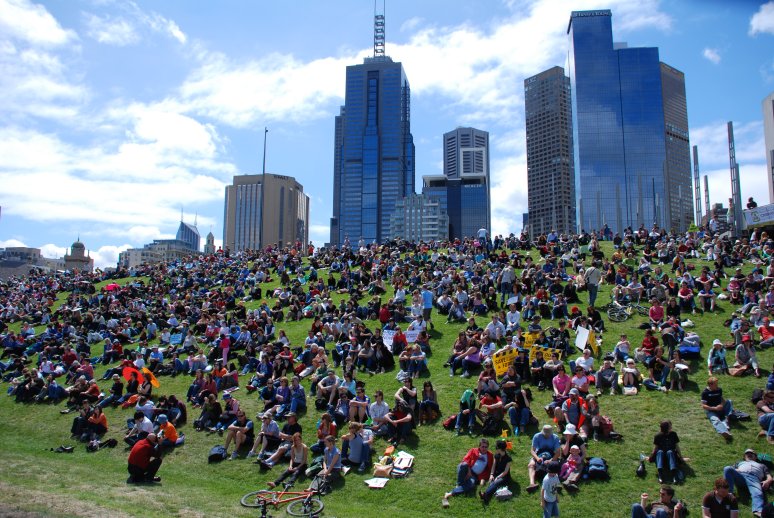
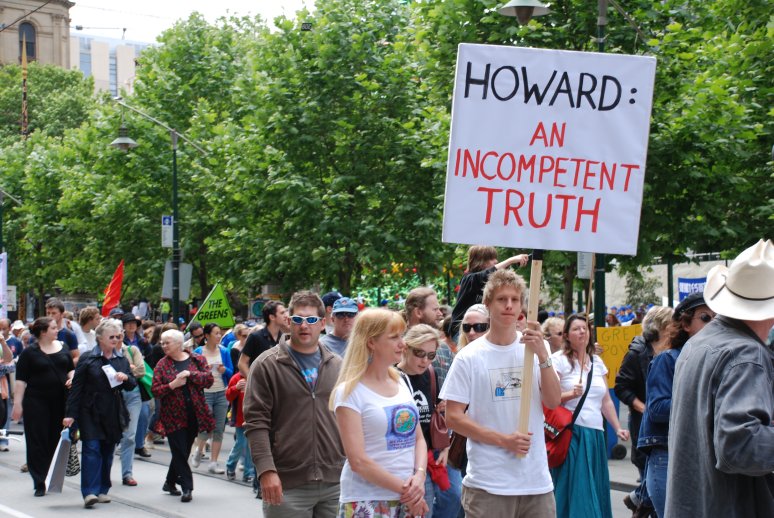
I attended today's Walk against Warming rally in Melbourne along with several thousand others . The walks were held across Australia. It was great to see so many people demonstrating their concern for this issue, which politicians have largely ignored until now. John Howard is still stuck in the mindset that saving us from global warming will be bad for business - when it the other way around. Energy efficient technologies and products are growth industries and exports for the future, not burning and exporting coal.

The Bracks government say they care, but they extended the life of Hazelwood - the southern hemisphere's most polluting power station - and they have only today announced a subsidy for energy efficient appliances. Why do they have to wait for an election to do this?

Meanwhile Ted Baillieu has committed the Liberals to ongoing support of the coal industry and getting rid or the Victorian Renewable Energy Target (VRET) program which would be step backwards.

Vote Green at the upcoming state election - there really is no viable alternative.

ABC news story about the rallies


Here are some more photos I took at the rally.


A windfarm attended


The crowd on the hill


The Greens were the only political party evident.


The endangered Orange bellied parrots attended.


John Howard rated a mention - for the wrong reasons.

A Baw Baw tree frog.

Tuesday, October 17, 2006

After no real debate, Howard "decides" Australia should go nuclear

After his disingenuous call in May this year for "a debate about nuclear energy", John Howard has now proclaimed that he thinks that Australia must embrace nuclear power (Age 17/10). The so-called debate now seems to be over before it has even really started.

Little wonder people become cynical when politicians hijack a vitally important issue like energy policy and avoid effective consultation with the broader community.

Even before Ziggy Switkowski's report on nuclear energy is published, Alexander Downer and Industry Minister Ian Macfarlane have both endorsed nuclear energy. How can they do this without the facts? Where is the companion report into long-term renewable energy options to balance the pro-nuclear report coming? This is a clear abrogation of political, democratic and scientific process.

We need to know what all the options and costs are. The huge government subsidies for electricity produced from burning coal need to be revealed. We need to know the real costs in constructing nuclear power stations. Uranium is another non-renewable resource - we need to know accurate predictions on how long it will last. We need to know how much water nuclear power stations need to operate - noting that we now face ongoing severe drought.

We need to know where proposed nuclear power stations will be sited, and where the waste will be stored. Do we really want to turn Australia into a nuclear waste dump? Do we want to expose ourselves to the risk of potentially catastrophic nuclear accidents?

No government has a mandate for unilateral action on such serious matters. We need a referendum to allow everyone to participate in the decision making process.

We have twenty solar panels on our house; we produce two thirds of the power we consume, and we provide power to the grid during peak usage times such as very hot days. This technology is genuinely renewable, available now, and a lot cheaper than building new power stations. It is a dereliction of duty for our politicians to ignore it.

Link: Nuclear power: the switch is on

Wednesday, September 20, 2006

Howard's dog whistle politics are a disgrace

I have been appalled by political comments made this week by John Howard, Peter Costello and Andrew Robb about how "Muslims must integrate better". Singling out any minority and saying they are "extreme" or that they "harbour terrorists" just polarises public opinion and feeds the fires of hatred within our community. In short, our politicians are creating and contributing to the problem they say they are trying to address. It is like trying to put out a fire with petrol.

There may be votes in it for them, but at what cost to Australia? There is general consensus that Australia is a less safe place following Howard's blind commitment to the futile and disastrous Iraq war and his anti-Muslim rhetoric. Of course he knew at the time there were no weapons of mass destruction - ASIO reports at the time told him so.

I was going to write a letter on this topic, then this one was published in The Age, which neatly sums up the concerns I have with the increasingly extremist and borderline racist views of the Howard government.


Playing politics
Janice Florence, Preston
The Age, 19 September 2006

I'm fed up with irresponsible politicians fiddling while Rome burns. They play wedge politics, stirring up artificial controversy about migrants, promoting division and suspicion. Is this a diversion from matters more difficult? Or is it just the usual jockeying for power by vying for the redneck vote?

How about doing something about the mountain of real problems we face: health, education, global warming, the energy crisis, the water crisis, environmental degradation, world poverty. Our overpaid, overindulged leaders should get over this petty game-playing and get on with the serious business of giving our civilisation a viable future.

Link

Monday, September 18, 2006

More information on why CNG is better than LPG

I have been doing further research into the benefits of using CNG for fuel and how it compares to LPG. It turns out that about 80% of Australia's LPG is produced from refining natural gas, while the remaining 20% is produced during refining crude oil.

However, the approximate composition of natural gas is as follows:


Component %
Methane (CH4) 80-95
Ethane (C2H6) 5-15
Propane (C3H8) and Butane (C4H10) < 5


Nitrogen, helium, carbon dioxide and trace amounts of hydrogen sulfide, water and odorants can also be present. Mercury is also present in small amounts in natural gas
extracted from some fields. The exact composition of natural gas varies between gas fields.

CNG is compressed methane.

LPG is a compressed blend of propane and butane.

Even though LPG is partly derived from natural gas supplies, it is much less abundant than methane. This makes CNG a much better long term option for fuel, even though it is still not created from a renewable source. Essentially, using CNG buys us more time to develop genuinely sustainable energy sources and technology for transport.

It is estimated that Australia has about 30 years supply of natural gas in existing fields, while crude oil supplies will run out in about 5 years.

Some other advantages that CNG has over LPG are:

  • Methane burns cleaner (no nitrous oxides) and is much less polluting than LPG
  • Methane is very close to hydrogen - so the infrastructure (tanks and compressors) for it could transition to hydrogen (this is not the case for LPG infrastructure)
It therefore makes much more sense to use methane as a fuel source than propane/butane.

Australia exports methane (as LNG) for about 3 cents per litre to China, and this contract is locked in for 20 years without any indexing to oil prices - which highlights the gross stupidity and economic incompetence of the Howard Government.

Write to your local politician and Mr Howard, and urge them to develop a strategy to transition to CNG for transport fuel, rather than LPG, petrol or diesel.

You could remind them of the lyrics of James Taylor's song "Traffic Jam" from his 1977 album "JT":

"Now I used to think that I was cool running around on fossil fuel,
Until I saw what I was doing was driving down the road to ruin."

For more information see:

Natural gas
CNG
LPG

Thursday, August 17, 2006

LPG subsidies will drive us down the road to ruin

Don’t waste your money on an LPG conversion. LPG is a by-product of refining crude oil, so when Australia runs out of oil in the next ten years, we run out of LPG too. The price of LPG will climb with the price of petrol as world oil supplies dwindle.

John Howard’s subsidy for LPG conversions for cars is short-term political opportunism that demonstrates he doesn’t have any real interest in sustainable long-term energy and transport alternatives.

For example, Australia is selling natural gas for 3 cents per litre to China by the shipload, when we could be running all our cars, trucks and buses on compressed natural gas (CNG). Our reserves of natural gas will last up to 30 years, so this would buy us more time as we transition to renewable alternatives.

You can even use home refilling stations to pressurise natural gas overnight and fill your car up – but these are not yet readily available in Australia.

It is a pity our politicians are ignoring CNG, just trying to buy votes, and intent on driving us all down the road to ruin.

Thursday, August 10, 2006

The problem is not petrol, its transport

Our political leaders such as John Howard and Steve Bracks have been quite remiss in not developing transport solutions that are sustainable and cost effective for the future.

We have known for some time that Australia's oil reserves will effectively run out in about a decade, Bass Strait oil runs out even sooner. Yet virtually no effort has been made to provide viable alternative transport modes and options. The focus has almost been exclusively on cars and trucks running on petroleum distillates (such as petrol or diesel), and on building freeways.

Now there is a predictable public backlash to petrol prices rising to nearly $1.50 per litre - which is inevitable as the world's oil supplies dwindle and wars rage . Within two years the price could rise to over $3.00 per litre, which will have massive flow-on effects for our economy and lifestyles.

So what are the gut reaction "solutions" proposed by some our parliamentarians?

  1. Ethanol (blended with petrol) - this is a nonsense solution as you need more fossil fuel inputs to grow crops and create then transport the ethanol than the energy value provided by the ethanol.
  2. Provide petrol subsidies (or removing the excise tax) - more short term thinking that will further encourage consumption and not address the root cause - that we are running out of oil
  3. LPG (liquid petroleum gas) - while this fuel is cheaper than petrol or diesel, it is a byproduct of refining crude oil, so it will run out when the oil reserves do, so this won't even buy us any time.
However, our reserves of natural gas (also from the oil fields) will last for over 30 years, and we could be running all our cars and trucks on compressed natural gas (CNG), but there has been no significant action on developing the infrastructure to supply this as fuel to consumers. Instead, we sell it by the shipload to China for 3 cents per litre, which is quite remarkable. We could use CNG to buy us more time to develop long term sustainable transport options.

Better public transport such as railways would also greatly reduce our increasing reliance on oil for fuel, but there has been very little investment in improving or extending our railway infrastructure or services over the last twenty years.

So, Greenprint suggestion #2 is to use CNG as fuel to buy us more time to develop long term solutions to our transport requirements.

Related article: Alaska puts heat on petrol, politicians

LETTER: Leadership lacking on petrol

Peter Bulkeley, Buderim, Qld
August 5, 2006

This is an interesting and topical letter that was published in The Age.

John Howard says of high petrol prices: "Everybody's got the problem, America's got it, Europe's got it, Asia's got it." Notice he did not include Middle Eastern countries, which are sitting on oceans of oil. In fact, Saudi Arabia cut the price of its petrol by 33 per cent in May to about 21 cents a litre.

If Australian governments had shown leadership over the past 20 years, most of us would be driving natural gas-powered vehicles rather than gloating over huge contracts with China and Japan to whom we give gas for a few cents a litre. Instead, we have a handful of cars and some public buses running on the fuel that is, to us, what oil is to other countries.

Mr Howard and his predecessors have not displayed the leadership needed to put relentless pressure on car makers to develop affordable natural gas cars and to stand up to the oil companies that resist that course. The oil companies' political clout, combined with the readiness of Mr Howard to follow George Bush into the Middle East to protect America's (and Exxon's) thirst for oil, makes the quest for a solution elusive. Not utilising our abundant natural gas is like the Saudis driving on $2-a-litre ethanol made from date peel.

Friday, July 07, 2006

In Perth, they have great cycle paths and new railway lines

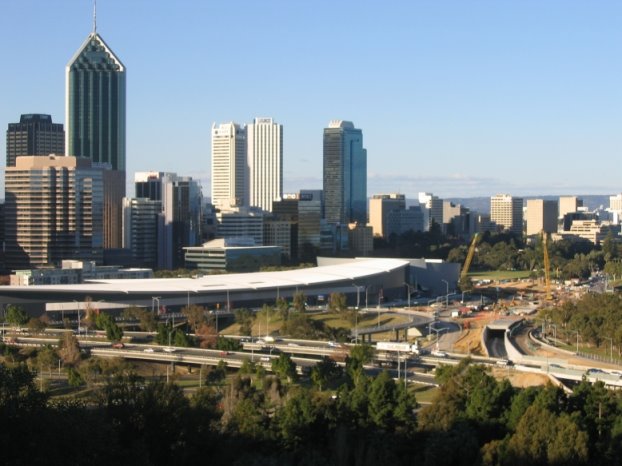
I visited Perth for a short stay in July, and have been pleasantly surprised by the great network of bicycle paths around the city. While cars are a very popular mode of transport, the bicycle is not neglected here.


Here is a bike path close to downtown Perth.

A new railway line is also under construction from downtown Perth to Mandurah to the south on the coast. This is an impressive undertaking with tunnels under the central business district.
This is contrast with Melbourne where no new railway lines to the suburbs have been built for decades, and many bicycle routes consist of lines painted on the road, which don't really provide adequate protection from cars. Most people just don't feel safe riding bicyles on busy suburban roads.

The new Perth-Mandurah railway line under construction.


With oil just hitting US$80 a barrel, I find it astounding that our governments are still basically fixated on cars and trucks as our primary mode of transport. It is great to see a more sensible approach in Western Australia. Bicycles would have to be the most environmentally friendly mode of urban transport, with rail coming second.

So, Greenprint suggestion #1 is to create a dedicated cycle path network to make bicycles a safe and convenient mode of transport. We need legislation that mandates the creation of bicycle paths along all metropolitan railway easements. We need bicycle paths so that people can safely use bicycles through our suburbs.

With Australian crude oil reserves running out by 2011, urgent action is needed on sustainable transport options. Our State and Federal governments mostly have their collective heads in buckets of asphalt. Send your local member a letter and ask them to lift their game.