After his disingenuous call in May this year for "a debate about nuclear energy", John Howard has now proclaimed that he thinks that Australia must embrace nuclear power (Age 17/10). The so-called debate now seems to be over before it has even really started.
Little wonder people become cynical when politicians hijack a vitally important issue like energy policy and avoid effective consultation with the broader community.
Even before Ziggy Switkowski's report on nuclear energy is published, Alexander Downer and Industry Minister Ian Macfarlane have both endorsed nuclear energy. How can they do this without the facts? Where is the companion report into long-term renewable energy options to balance the pro-nuclear report coming? This is a clear abrogation of political, democratic and scientific process.
We need to know what all the options and costs are. The huge government subsidies for electricity produced from burning coal need to be revealed. We need to know the real costs in constructing nuclear power stations. Uranium is another non-renewable resource - we need to know accurate predictions on how long it will last. We need to know how much water nuclear power stations need to operate - noting that we now face ongoing severe drought.
We need to know where proposed nuclear power stations will be sited, and where the waste will be stored. Do we really want to turn Australia into a nuclear waste dump? Do we want to expose ourselves to the risk of potentially catastrophic nuclear accidents?
No government has a mandate for unilateral action on such serious matters. We need a referendum to allow everyone to participate in the decision making process.
We have twenty solar panels on our house; we produce two thirds of the power we consume, and we provide power to the grid during peak usage times such as very hot days. This technology is genuinely renewable, available now, and a lot cheaper than building new power stations. It is a dereliction of duty for our politicians to ignore it.
Link: Nuclear power: the switch is on
Tuesday, October 17, 2006


Wednesday, September 20, 2006
Howard's dog whistle politics are a disgrace
I have been appalled by political comments made this week by John Howard, Peter Costello and Andrew Robb about how "Muslims must integrate better". Singling out any minority and saying they are "extreme" or that they "harbour terrorists" just polarises public opinion and feeds the fires of hatred within our community. In short, our politicians are creating and contributing to the problem they say they are trying to address. It is like trying to put out a fire with petrol.
There may be votes in it for them, but at what cost to Australia? There is general consensus that Australia is a less safe place following Howard's blind commitment to the futile and disastrous Iraq war and his anti-Muslim rhetoric. Of course he knew at the time there were no weapons of mass destruction - ASIO reports at the time told him so.
I was going to write a letter on this topic, then this one was published in The Age, which neatly sums up the concerns I have with the increasingly extremist and borderline racist views of the Howard government.
Playing politics
Janice Florence, Preston
The Age, 19 September 2006
I'm fed up with irresponsible politicians fiddling while Rome burns. They play wedge politics, stirring up artificial controversy about migrants, promoting division and suspicion. Is this a diversion from matters more difficult? Or is it just the usual jockeying for power by vying for the redneck vote?
How about doing something about the mountain of real problems we face: health, education, global warming, the energy crisis, the water crisis, environmental degradation, world poverty. Our overpaid, overindulged leaders should get over this petty game-playing and get on with the serious business of giving our civilisation a viable future.
Link
There may be votes in it for them, but at what cost to Australia? There is general consensus that Australia is a less safe place following Howard's blind commitment to the futile and disastrous Iraq war and his anti-Muslim rhetoric. Of course he knew at the time there were no weapons of mass destruction - ASIO reports at the time told him so.
I was going to write a letter on this topic, then this one was published in The Age, which neatly sums up the concerns I have with the increasingly extremist and borderline racist views of the Howard government.
Playing politics
Janice Florence, Preston
The Age, 19 September 2006
I'm fed up with irresponsible politicians fiddling while Rome burns. They play wedge politics, stirring up artificial controversy about migrants, promoting division and suspicion. Is this a diversion from matters more difficult? Or is it just the usual jockeying for power by vying for the redneck vote?
How about doing something about the mountain of real problems we face: health, education, global warming, the energy crisis, the water crisis, environmental degradation, world poverty. Our overpaid, overindulged leaders should get over this petty game-playing and get on with the serious business of giving our civilisation a viable future.
Link
Monday, September 18, 2006
More information on why CNG is better than LPG
I have been doing further research into the benefits of using CNG for fuel and how it compares to LPG. It turns out that about 80% of Australia's LPG is produced from refining natural gas, while the remaining 20% is produced during refining crude oil.
However, the approximate composition of natural gas is as follows:
Even though LPG is partly derived from natural gas supplies, it is much less abundant than methane. This makes CNG a much better long term option for fuel, even though it is still not created from a renewable source. Essentially, using CNG buys us more time to develop genuinely sustainable energy sources and technology for transport.
It is estimated that Australia has about 30 years supply of natural gas in existing fields, while crude oil supplies will run out in about 5 years.
Some other advantages that CNG has over LPG are:
Australia exports methane (as LNG) for about 3 cents per litre to China, and this contract is locked in for 20 years without any indexing to oil prices - which highlights the gross stupidity and economic incompetence of the Howard Government.
Write to your local politician and Mr Howard, and urge them to develop a strategy to transition to CNG for transport fuel, rather than LPG, petrol or diesel.
You could remind them of the lyrics of James Taylor's song "Traffic Jam" from his 1977 album "JT":
"Now I used to think that I was cool running around on fossil fuel,
Until I saw what I was doing was driving down the road to ruin."
For more information see:
Natural gas
CNG
LPG
However, the approximate composition of natural gas is as follows:
| Component | % |
|---|---|
| Methane (CH4) | 80-95 |
| Ethane (C2H6) | 5-15 |
| Propane (C3H8) and Butane (C4H10) | < 5 |
Nitrogen, helium, carbon dioxide and trace amounts of hydrogen sulfide, water and odorants can also be present. Mercury is also present in small amounts in natural gas
extracted from some fields. The exact composition of natural gas varies between gas fields.
CNG is compressed methane.
LPG is a compressed blend of propane and butane.Even though LPG is partly derived from natural gas supplies, it is much less abundant than methane. This makes CNG a much better long term option for fuel, even though it is still not created from a renewable source. Essentially, using CNG buys us more time to develop genuinely sustainable energy sources and technology for transport.
It is estimated that Australia has about 30 years supply of natural gas in existing fields, while crude oil supplies will run out in about 5 years.
Some other advantages that CNG has over LPG are:
- Methane burns cleaner (no nitrous oxides) and is much less polluting than LPG
- Methane is very close to hydrogen - so the infrastructure (tanks and compressors) for it could transition to hydrogen (this is not the case for LPG infrastructure)
Australia exports methane (as LNG) for about 3 cents per litre to China, and this contract is locked in for 20 years without any indexing to oil prices - which highlights the gross stupidity and economic incompetence of the Howard Government.
Write to your local politician and Mr Howard, and urge them to develop a strategy to transition to CNG for transport fuel, rather than LPG, petrol or diesel.
You could remind them of the lyrics of James Taylor's song "Traffic Jam" from his 1977 album "JT":
"Now I used to think that I was cool running around on fossil fuel,
Until I saw what I was doing was driving down the road to ruin."
For more information see:
Natural gas
CNG
LPG
Thursday, August 17, 2006
LPG subsidies will drive us down the road to ruin
Don’t waste your money on an LPG conversion. LPG is a by-product of refining crude oil, so when Australia runs out of oil in the next ten years, we run out of LPG too. The price of LPG will climb with the price of petrol as world oil supplies dwindle.
John Howard’s subsidy for LPG conversions for cars is short-term political opportunism that demonstrates he doesn’t have any real interest in sustainable long-term energy and transport alternatives.
For example, Australia is selling natural gas for 3 cents per litre to China by the shipload, when we could be running all our cars, trucks and buses on compressed natural gas (CNG). Our reserves of natural gas will last up to 30 years, so this would buy us more time as we transition to renewable alternatives.
You can even use home refilling stations to pressurise natural gas overnight and fill your car up – but these are not yet readily available in Australia.
It is a pity our politicians are ignoring CNG, just trying to buy votes, and intent on driving us all down the road to ruin.
John Howard’s subsidy for LPG conversions for cars is short-term political opportunism that demonstrates he doesn’t have any real interest in sustainable long-term energy and transport alternatives.
For example, Australia is selling natural gas for 3 cents per litre to China by the shipload, when we could be running all our cars, trucks and buses on compressed natural gas (CNG). Our reserves of natural gas will last up to 30 years, so this would buy us more time as we transition to renewable alternatives.
You can even use home refilling stations to pressurise natural gas overnight and fill your car up – but these are not yet readily available in Australia.
It is a pity our politicians are ignoring CNG, just trying to buy votes, and intent on driving us all down the road to ruin.
Thursday, August 10, 2006
The problem is not petrol, its transport
Our political leaders such as John Howard and Steve Bracks have been quite remiss in not developing transport solutions that are sustainable and cost effective for the future.
We have known for some time that Australia's oil reserves will effectively run out in about a decade, Bass Strait oil runs out even sooner. Yet virtually no effort has been made to provide viable alternative transport modes and options. The focus has almost been exclusively on cars and trucks running on petroleum distillates (such as petrol or diesel), and on building freeways.
Now there is a predictable public backlash to petrol prices rising to nearly $1.50 per litre - which is inevitable as the world's oil supplies dwindle and wars rage . Within two years the price could rise to over $3.00 per litre, which will have massive flow-on effects for our economy and lifestyles.
So what are the gut reaction "solutions" proposed by some our parliamentarians?
Better public transport such as railways would also greatly reduce our increasing reliance on oil for fuel, but there has been very little investment in improving or extending our railway infrastructure or services over the last twenty years.
So, Greenprint suggestion #2 is to use CNG as fuel to buy us more time to develop long term solutions to our transport requirements.
Related article: Alaska puts heat on petrol, politicians
We have known for some time that Australia's oil reserves will effectively run out in about a decade, Bass Strait oil runs out even sooner. Yet virtually no effort has been made to provide viable alternative transport modes and options. The focus has almost been exclusively on cars and trucks running on petroleum distillates (such as petrol or diesel), and on building freeways.
Now there is a predictable public backlash to petrol prices rising to nearly $1.50 per litre - which is inevitable as the world's oil supplies dwindle and wars rage . Within two years the price could rise to over $3.00 per litre, which will have massive flow-on effects for our economy and lifestyles.
So what are the gut reaction "solutions" proposed by some our parliamentarians?
- Ethanol (blended with petrol) - this is a nonsense solution as you need more fossil fuel inputs to grow crops and create then transport the ethanol than the energy value provided by the ethanol.
- Provide petrol subsidies (or removing the excise tax) - more short term thinking that will further encourage consumption and not address the root cause - that we are running out of oil
- LPG (liquid petroleum gas) - while this fuel is cheaper than petrol or diesel, it is a byproduct of refining crude oil, so it will run out when the oil reserves do, so this won't even buy us any time.
Better public transport such as railways would also greatly reduce our increasing reliance on oil for fuel, but there has been very little investment in improving or extending our railway infrastructure or services over the last twenty years.
So, Greenprint suggestion #2 is to use CNG as fuel to buy us more time to develop long term solutions to our transport requirements.
Related article: Alaska puts heat on petrol, politicians
LETTER: Leadership lacking on petrol
Peter Bulkeley, Buderim, Qld
August 5, 2006
This is an interesting and topical letter that was published in The Age.
John Howard says of high petrol prices: "Everybody's got the problem, America's got it, Europe's got it, Asia's got it." Notice he did not include Middle Eastern countries, which are sitting on oceans of oil. In fact, Saudi Arabia cut the price of its petrol by 33 per cent in May to about 21 cents a litre.
August 5, 2006
This is an interesting and topical letter that was published in The Age.
John Howard says of high petrol prices: "Everybody's got the problem, America's got it, Europe's got it, Asia's got it." Notice he did not include Middle Eastern countries, which are sitting on oceans of oil. In fact, Saudi Arabia cut the price of its petrol by 33 per cent in May to about 21 cents a litre.
If Australian governments had shown leadership over the past 20 years, most of us would be driving natural gas-powered vehicles rather than gloating over huge contracts with China and Japan to whom we give gas for a few cents a litre. Instead, we have a handful of cars and some public buses running on the fuel that is, to us, what oil is to other countries.
Mr Howard and his predecessors have not displayed the leadership needed to put relentless pressure on car makers to develop affordable natural gas cars and to stand up to the oil companies that resist that course. The oil companies' political clout, combined with the readiness of Mr Howard to follow George Bush into the Middle East to protect America's (and Exxon's) thirst for oil, makes the quest for a solution elusive. Not utilising our abundant natural gas is like the Saudis driving on $2-a-litre ethanol made from date peel.
Friday, July 07, 2006
In Perth, they have great cycle paths and new railway lines
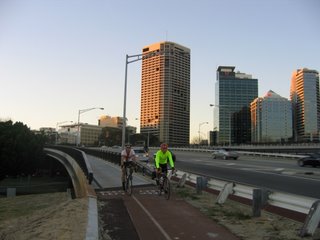
I visited Perth for a short stay in July, and have been pleasantly surprised by the great network of bicycle paths around the city. While cars are a very popular mode of transport, the bicycle is not neglected here.
A new railway line is also under construction from downtown Perth to Mandurah to the south on the coast. This is an impressive undertaking with tunnels under the central business district.
This is contrast with Melbourne where no new railway lines to the suburbs have been built for decades, and many bicycle routes consist of lines painted on the road, which don't really provide adequate protection from cars. Most people just don't feel safe riding bicyles on busy suburban roads.
 The new Perth-Mandurah railway line under construction.
With oil just hitting US$80 a barrel, I find it astounding that our governments are still basically fixated on cars and trucks as our primary mode of transport. It is great to see a more sensible approach in Western Australia. Bicycles would have to be the most environmentally friendly mode of urban transport, with rail coming second.
So, Greenprint suggestion #1 is to create a dedicated cycle path network to make bicycles a safe and convenient mode of transport. We need legislation that mandates the creation of bicycle paths along all metropolitan railway easements. We need bicycle paths so that people can safely use bicycles through our suburbs.
With Australian crude oil reserves running out by 2011, urgent action is needed on sustainable transport options. Our State and Federal governments mostly have their collective heads in buckets of asphalt. Send your local member a letter and ask them to lift their game.

Here is a bike path close to downtown Perth.
A new railway line is also under construction from downtown Perth to Mandurah to the south on the coast. This is an impressive undertaking with tunnels under the central business district.
This is contrast with Melbourne where no new railway lines to the suburbs have been built for decades, and many bicycle routes consist of lines painted on the road, which don't really provide adequate protection from cars. Most people just don't feel safe riding bicyles on busy suburban roads.
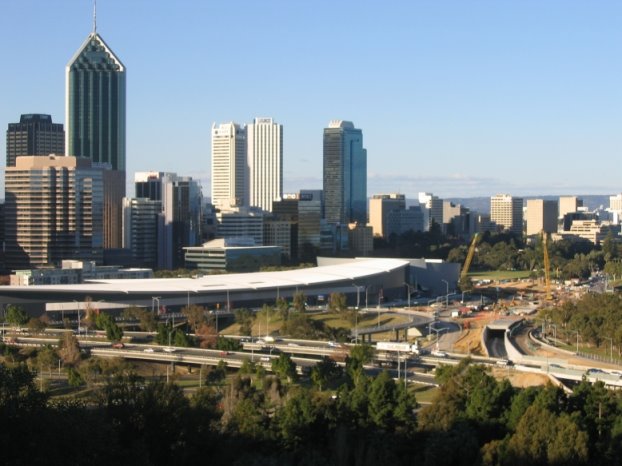 The new Perth-Mandurah railway line under construction.
With oil just hitting US$80 a barrel, I find it astounding that our governments are still basically fixated on cars and trucks as our primary mode of transport. It is great to see a more sensible approach in Western Australia. Bicycles would have to be the most environmentally friendly mode of urban transport, with rail coming second.
So, Greenprint suggestion #1 is to create a dedicated cycle path network to make bicycles a safe and convenient mode of transport. We need legislation that mandates the creation of bicycle paths along all metropolitan railway easements. We need bicycle paths so that people can safely use bicycles through our suburbs.
With Australian crude oil reserves running out by 2011, urgent action is needed on sustainable transport options. Our State and Federal governments mostly have their collective heads in buckets of asphalt. Send your local member a letter and ask them to lift their game.
Sunday, May 14, 2006
We need a real nuclear debate
Recent talk of a “debate on nuclear energy” by John Howard and Peter Costello and others raise the issue about how our democracy should handle this topic. In reality, there really is no debate. The public sees and hears a variety of opinions expressed by politicians and think tank consultants aired in newspapers and on television. Views can also be expressed via editorial comment (Age 30/4/06).
However, this is no debate. The dialogue is edited and controlled by media interests and public relations consultancies. The public can engage in a limited way by writing letter to editors or to politicians. The former has a slim chance of being published and the latter is just put onto a pile.
In the run up to the next election, the nuclear power issue may get some more airtime. However, if both the Coalition and the ALP under Kim Beasley have similar policies, Australian’s who don’t wish to embrace nuclear power, nuclear waste and expanded uranium exports can only express their views at the ballot box by voting for a minor party such as the Greens, who oppose the development and spread of nuclear power.
Unfortunately, as the Greens are unlikely to win government, this means Australia will be stuck with policies that may support the development of nuclear power, the storage of toxic nuclear waste, increased uranium exports, and anything else the major parties deem appropriate and curiously agree upon.
We need to have a genuine debate on whether Australia should embrace nuclear power or not. We need a debate in the federal parliament so we can see and hear what our politicians’ views are and what they are based on. We also need to see how they are representing their constituent’s views.
We need an independent scientific and social enquiry to assess the pros and cons of nuclear power based on factual information, not just opinions, which the Australian public can read and assess. This enquiry should take public submissions.
Then we need a referendum that asks Australian voters whether they support increased uranium exports, investment in nuclear power over renewable energy technologies, and whether they agree with Australian becoming a dumping ground for other country’s nuclear waste.
We need a proper public debate that is well informed, followed by genuine democratic process so that we all have input in determining how our energy needs are met for the future.
Links
However, this is no debate. The dialogue is edited and controlled by media interests and public relations consultancies. The public can engage in a limited way by writing letter to editors or to politicians. The former has a slim chance of being published and the latter is just put onto a pile.
In the run up to the next election, the nuclear power issue may get some more airtime. However, if both the Coalition and the ALP under Kim Beasley have similar policies, Australian’s who don’t wish to embrace nuclear power, nuclear waste and expanded uranium exports can only express their views at the ballot box by voting for a minor party such as the Greens, who oppose the development and spread of nuclear power.
Unfortunately, as the Greens are unlikely to win government, this means Australia will be stuck with policies that may support the development of nuclear power, the storage of toxic nuclear waste, increased uranium exports, and anything else the major parties deem appropriate and curiously agree upon.
We need to have a genuine debate on whether Australia should embrace nuclear power or not. We need a debate in the federal parliament so we can see and hear what our politicians’ views are and what they are based on. We also need to see how they are representing their constituent’s views.
We need an independent scientific and social enquiry to assess the pros and cons of nuclear power based on factual information, not just opinions, which the Australian public can read and assess. This enquiry should take public submissions.
Then we need a referendum that asks Australian voters whether they support increased uranium exports, investment in nuclear power over renewable energy technologies, and whether they agree with Australian becoming a dumping ground for other country’s nuclear waste.
We need a proper public debate that is well informed, followed by genuine democratic process so that we all have input in determining how our energy needs are met for the future.
Links
- A disaster we must not repeat, Christine Milne, April 26, 2006
- Nuclear power: it's time to face the realities, Age editorial, April 30 2006
- We want big role in nuclear club: Howard, Michael Gordon, May 14, 2006
- Safely, greenly nuclear, Ian Hore Lacy, April 28 2006
- GHOST TOWN - KiddofSpeed - Chernobyl Pictures, Elena
Friday, April 21, 2006
LETTER: Thwaites playing possum with our water
Environment Minister Thwaites encouraging us all to reduce our water consumption by 30 percent (The Age 21/04) with the Government’s new draft water strategy is a commendable initiative.
Unfortunately, he is taking no action to prevent the serious water losses caused by logging in our water catchments.
Prevention is better than cure, but in this case we can have both.
Leadbeater’s possum lives in these catchment forests too. The last one in captivity at Healesville has just died. Protecting our catchment forests will help the survival of this threatened species – which is also Victoria’s faunal emblem.
Thwaites should stop playing politics and take real action to protect our forests, our threatened species and our water resources.
LETTER: Bolt's rant on West Papua shows ignorance and malice
Andrew Bolt’s recent diatribe (HeraldSun 12/4) supporting Indonesia’s mistreatment of West Papuans flies in the face of clear evidence that serious human rights abuses are occurring there. These abuses have been validated by the Immigration Department when they granted temporary protection visas to 42 of the West Papuans who arrived recently, and by numerous other exiled West Papuans, such as Jacob Rumbiak, who have suffered at the hands of the Indonesians.
Bolt’s intemperate attack on several academics, activists, churchmen, unionists and politicians (Bob Brown in particular) who have voiced concerns about human rights abuses in West Papua is ill informed and quite inappropriate.
Church groups have estimated that over 100,000 people have died under Indonesian rule. According to Amnesty International Australia, "reports include extrajudicial executions, disappearances, torture and ill-treatment and arbitrary detentions in Papua Province, where there is an ongoing struggle for independence from Indonesia."
It is unacceptable that the Howard Government has recently decided to start locking up children behind razor wire again and resurrected the so-called “Pacific solution” for asylum seekers who reach our shores in response to Indonesia’s recent protestations.
Encouraging and supporting democracy Indonesia doesn't preclude us from drawing attention to human rights abuses or giving safe harbour to those who flee from it.
Standing up for human rights is not always easy or politically expedient. It is simply the right thing to do.
Bolt's rantThursday, April 20, 2006
Howard and Costello squander opportunity for genuine tax reform
So John Howard thinks that doing tax returns is popular (Age 20/4). Well they aren’t for me, or the other 80 per cent of Australians that find them too onerous and confusing to do themselves.
Paying tax agents over $1 billion annually to do our tax returns is a monumental waste of our money – which would be better spent improving health or education.
Instead, Howard and Costello support a complex and inefficient income tax system that constantly raises our tax via bracket creep so they can hand out tax cuts during election years. An honest government would index the brackets.
With a big surplus this year, Howard and Costello are squandering a great opportunity for genuine tax reform that could simplify our lives and address the creeping poverty trap that affects many lower income people.
Paying tax agents over $1 billion annually to do our tax returns is a monumental waste of our money – which would be better spent improving health or education.
Instead, Howard and Costello support a complex and inefficient income tax system that constantly raises our tax via bracket creep so they can hand out tax cuts during election years. An honest government would index the brackets.
With a big surplus this year, Howard and Costello are squandering a great opportunity for genuine tax reform that could simplify our lives and address the creeping poverty trap that affects many lower income people.
Thursday, April 06, 2006
Minister Campbell uses the Orange Bellied parrot as an excuse to block wind farms
Environment Minister Ian Campbell’s blocking of the Bald Hills windfarm is ill considered on a number of counts.
Campbell omits to mention that the Orange-bellied Parrot report states that “analyses suggest that such action will have extremely limited beneficial value to conservation of the parrot without addressing very much greater adverse effects that are currently operating against it”.
The parrot migrates to Cape Otway then spreads along the coast West to South Australia and East to Wilsons Promontary. Following Campbell’s dubious rationale, all windfarms in these areas must also close, which would shut down Victoria’s entire wind energy industry.
In addition, Minister Campbell is doing nothing to protect the habitat of other endangered species such as the Powerful Owl and Leadbeater’s possum, whose habitat is being destroyed by the clearfell logging of our remaining native forests.
The parrot is critically endangered, with only 200 thought to remain in the wild. A coordinated program addressing all factors impacting its survival is required.
Minister Campbell should take genuine action to protect the habitat of all our endangered species, rather than use them as an excuse for politically motivated policy decisions in marginal seats. He needs to take his portfolio more seriously.
Tuesday, March 28, 2006
Bracks must act to protect Leadbeater's possum habitat
It is sad news indeed that only one Leadbeater's possum, Victoria’s state faunal emblem, remains in captivity after its mate died in a Melbourne sanctuary.
The possum’s survival is under threat because clearfell logging of the Central Highlands, including Melbourne’s water catchments, is destroying its habitat. It needs old trees with hollows for its nests.
Steve Bracks should act immediately to protect these forests and prevent the possum's extinction in its natural habitat. He should also protect the remaining forest habit of Karak, the Red-tailed Black Cockatoo which was the Commonwealth Games mascot, to assist its survival in the wild too.
Thursday, February 16, 2006
LETTER: RU486, ministerial accountability and democracy
It is encouraging that the RU-486 private members bill passed through the House of Representatives, putting the decision on the availability of the drug in the capable hands of the TGA.
However, after all the debates and impassioned speeches, there was final vote taken on the Bill was not counted, so we don’t know how our MPs have voted, which is a convenient abrogation of democratic accountability to the electorate.
As Minister Abbott and Prime Minister John Howard have been calling this a 'vote of no confidence' in Abbot as Health minister, will he now resign?
And will Danna Vale’s extremist views on Muslims go unchecked? She and Tony Abbot provided perfect examples of why the decision to approve RU-486 should NOT be in the hands of parliamentarians.
This bill was a victory for women and democracy. Without the overwhelming support of women parliamentarians it would not have passed. It is quite clear that we need more women in parliament, and that conscience votes improve democratic process.
Thursday, February 09, 2006
Logging breaches are unnacceptable - the Bracks government should act
It is simply unacceptable that the Bracks’ government has taken no action when recent Environment Protection Agency audits found serious logging breaches where protected trees in National Parks were felled and endangered species where threatened (Age 9/2).
I was recently fined for traveling on the train with an unvalidated ticket, despite attempting to validate it and clearly communicating this to the Minister for Transport and the Premier. Why is zero tolerance and the full weight of the law exercised against so-called fare evaders on public transport, yet loggers who clearly break the law go unpunished?
It is apparent that the mismanagement of our forests extends past clear felling of our old growth forests for low value export woodchips to a lack of compliance with the law.
Acting Environment Minister Candy Broad should take immediate steps to ensure prosecutions rather than make excuses for Government inaction and a logging industry that is out of control and destroying our old growth forests.Friday, February 03, 2006
RU486, the conscience vote and the seperation of powers
Australia's federal MPs should exercise their conscience votes in favour of the use and availability of RU486.
RU486 is safe and effective. The World Health Organisation and the AMA advocate for the availability of RU486, because it is arguably safer than the already safe surgical abortion procedure (both at the acceptable level of approximately 1 death per one hundred thousand). International consensus is that RU486 is also the most effective method of abortion for gestation at less than 7 weeks.
RU486 will not lead to increased abortions. A woman’s decision to have an abortion, whether surgically or by medication, is never taken lightly. There is no evidence to suggest that the introduction of RU486 would increase the likelihood of a woman terminating a pregnancy.
Access to RU486 should be a medical decision, not a political one. A politician who has no medical expertise should not determine a woman’s access to RU486. Instead, access to abortion medications should be determined by health professionals at the Therapeutic Goods Administration. The public interest is not served by having this important decision held solely in the hands of one man such as Tony Abbott, who is not respecting the separation of powers doctrine between his parliamentary role in forming legislation (in Government) and his executive role (as Minister) in charge of the Health portfolio.
RU486 is safe and effective. The World Health Organisation and the AMA advocate for the availability of RU486, because it is arguably safer than the already safe surgical abortion procedure (both at the acceptable level of approximately 1 death per one hundred thousand). International consensus is that RU486 is also the most effective method of abortion for gestation at less than 7 weeks.
RU486 will not lead to increased abortions. A woman’s decision to have an abortion, whether surgically or by medication, is never taken lightly. There is no evidence to suggest that the introduction of RU486 would increase the likelihood of a woman terminating a pregnancy.
Access to RU486 should be a medical decision, not a political one. A politician who has no medical expertise should not determine a woman’s access to RU486. Instead, access to abortion medications should be determined by health professionals at the Therapeutic Goods Administration. The public interest is not served by having this important decision held solely in the hands of one man such as Tony Abbott, who is not respecting the separation of powers doctrine between his parliamentary role in forming legislation (in Government) and his executive role (as Minister) in charge of the Health portfolio.
Thursday, January 26, 2006
Australian history and our national identity
John Howard’s recent “ claiming of victory in national culture wars” is yet another example of his penchant for denying both our historical roots and Australia’s current position on national identity and the appalling circumstances that many indigenous Australian’s live in.
He is also divisive and narrow-minded in his use of language by “claiming victory” in a referring to “a war” and labelling considerations about our national psyche and identity as a “phoney debate”.
The Australia I live in is still a colony of Great Britain with a British Queen as the head of state, when I and a clear majority of Australians believe it should be a republic.
Indigenous Australians are discriminated against by Government policies. They suffer low employment, low life expectancy, high substance abuse, very poor health and often appalling housing conditions. They have no treaty, and their attempts to gain native title have been treated with contempt. Equating seven generations of white Australian residency with over 40,000 years of indigenous occupation is a bit rich. But I do agree that there should be better recognition of and education about indigenous Australians, who did lead truly sustainable lives.
With the Cronulla riots, we are also faced with the recent re-emergence of racism, and a level of denial from John Howard. Well John, denying racism it won’t make it go away.
I am not sure exactly how John Howard thinks that changes to the way children are taught about Australian history will improve matters, or what his speculation is based on. Is the Howard Government going to start rewriting our history books based on their neo-conservative and revisionist philosophy? Will they mandate these for state and private school curricular? Will compliance to this be policed?
The way forward to building a more cohesive and forward looking Australia is to acknowledge our true history, make a treaty with indigenous Australians, give them title to their lands and work with them to improve their health and housing. We should also become a republic with an Australian head of state. And we need to counter emergent racism with improved education and by building consensus between all Australians, whatever their origin, rather than a continued focus on division and revisionism. Our national values and character need to be built and embraced by all Australians, not just on the jingoism of neo-conservative politicians. They need to be reflected and protected by a bill or rights.
Our young people are at risk of being served up an education diet of selective and biased claptrap proscribed by a ministry of propaganda, then being scared and frightened by the increased threat from terrorism that the Howard government’s policies have exposed Australia to. Let’s work together to make sure this does not happen.
Tuesday, January 24, 2006
Julian McGauran abandons his party, principles and country constituents
Senator Julian McGauran is spot on when he states there is no significant difference between the Liberal and National parties on policy matters - the Nationals have been drifting closer to the Liberal party for years.
Both support the fire sale of Telstra, which will compromise communication services in the bush. Both support the dubious and flawed so called Free Trade Agreement between Australia and the US, which benefits the US but not us.
And now we have the combined spectacle and sideshow of Barnaby Joyce pontificating about crossing the floor, but allowing the Howard Government to slash funding for student services and proceed with the sale of Telstra.
Julian McGauran has abandoned his party, his principles and his country constituents to boost his own political fortune and curry favour with the city-centric Liberals.
Abandoned by the Nationals, ignored by the Liberals and overlooked by Labor, country people would do well to consider voting Green at the next election.
LETTER: A red-hot foretaste of the hell to come
Author: Dr Peter Christoff, vice-president, Australian Conservation Foundation
Published in The Age (letter), 2nd January 2006
For the past nine years, John Howard has told the world to go to hell on the issue of climate change. Well, Saturday's record scorcher gave us a foretaste of exactly how hot that version of hell will be. The future is one of temperature extremes, and a catastrophic transformation of the natural - and human world, unless we act with extreme urgency and effectiveness to counter global warming.
Australia has refused to cooperate with attempts to create an effective and binding international treaty to tackle global warming. It is now truly time for the Howard Government to outline a plan of genuine cooperation with the international community on this, the most important and threatening of global environmental issues.
Beginning with ratification of the Kyoto Protocol, such action must also include a national strategy for adaptation to climate change, and substantial measures to wean Australia off its fossil fuel-addicted economy.
Thursday, January 05, 2006
Victoria needs more trains and an integrated transport plan
Victoria’s trains are clearly routinely overcrowded, and yet Transport Minister Peter Batchelor is sitting on his hands. The Victorian Government has invested next to nothing on improving our rail transport infrastructure, yet they have spent over $360 million on the Craigieburn Bypass and have completed a $2.5 billion tender to build the EastLink tollway route through Melbourne's east.
Motor vehicles are not the answer to Melbourne’s and Victoria’s transport needs as they require the use of petroleum-based fuels, which Australia will run out of in the not too distant future, and they just clog up our city. The Bracks Government’s priorities are wrong, partly because they have not developed an integrated transport strategy instead of just building more roads, and because they are out of touch with what the public wants.
Now we hear from Mr Batchelor (Age 5/1) that our already overcrowded trains will “still be safe” when we cram in more hapless commuter sardines, despite the lack of a maximum safe passenger load specified for trains. Wake up Minister, we need more trains, more tracks, a more frequent and better integrated service and some forward planning. Instead we are just getting more roads and more ticket inspectors. Public transport is looming as a big issue for 2006 State election. Perhaps this will sharpen the Bracks Government’s focus.
This was submitted as a Letter to the Editor to The Age
Subscribe to:
Posts (Atom)